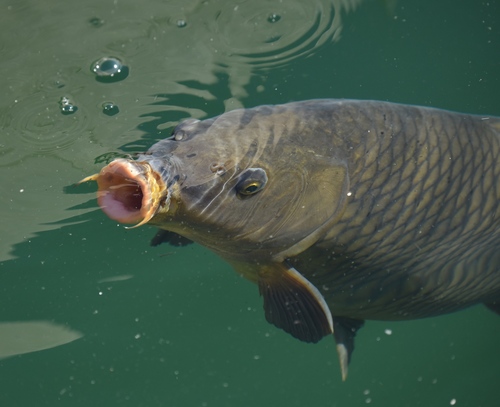
European Carp
Cyprinus carpio
The European Carp is one of the world's most successful and adaptable fish, known for its impressive size, golden-scaled beauty, and powerful presence in freshwater ecosystems.
Quick Identification
Size
Typically 40–80 cm (16–31 in) and 2–14 kg (4–31 lbs), though trophy specimens can exceed 120 cm (47 in) and 40 kg (88 lbs).
Colors
Back is olive-green to brassy brown, fading to yellow or white on the belly; fins are often reddish or dusky; scales frequently have a dark spot at the base and a dark border.
Key Features
- Two pairs of barbels (whiskers) on the upper lip
- Long dorsal fin base with a stout, serrated spine
- Large, heavy cycloid scales (except in 'mirror' or 'leather' varieties)
- Protrusible mouth that extends downward for bottom feeding
When You’ll See Them
Geographic range
Where Does the European Carp Live?
Native to the freshwater basins of Eastern Europe and Central Asia, the European Carp has been introduced to every continent except Antarctica. They are now ubiquitous across North America, Australia, and Western Europe, where they thrive in a diverse array of climates ranging from temperate river systems to tropical wetlands.
Basemap © OpenStreetMap contributors
Behavior
European Carp are highly social, intelligent fish that typically move in small to medium-sized shoals. They are notorious 'muckers,' a behavior where they root through the substrate to find food, often uprooting aquatic vegetation and increasing water turbidity. This foraging style is a primary reason they are considered ecologically disruptive in areas where they are introduced, as it can destroy habitat for other species.
These fish are exceptionally hardy and can survive in poor water conditions that would kill other species, including low oxygen levels and high pollution. In the spring, they exhibit dramatic spawning behavior in shallow waters, where large groups can be seen splashing loudly and thrashing near the surface as they deposit eggs among weeds. While often wary of humans in high-pressure fishing areas, they can become quite bold in urban ponds where they are frequently fed by visitors.
EverydayEarth exclusive
Camera Tips
Capturing European Carp on camera requires a specialized approach since they are submerged. The most effective method for backyard pond owners or trail cam enthusiasts is to use a pole-mounted waterproof camera (like a GoPro or a dedicated underwater trail cam) positioned in the shallows. Aim the camera horizontally across a flat, silty area about 12-24 inches deep. If you are shooting from above the water, a circular polarizing filter is essential to cut through surface glare and reveal the fish below.
To bring Carp directly in front of your lens, 'pre-baiting' is your best friend. Create a localized feeding station using sweet corn, bread crumbs, or specialized 'boilies' (scented dough balls). Carp have a keen sense of smell and will quickly locate the bait. For the best action shots, place the bait on a flat rock or a clear patch of sand; this forces the fish to stay in a specific focal plane while they use their vacuum-like mouths to suck up the food.
Timing is critical for high-energy footage. During the spring spawning season (usually when water temperatures hit 17-20°C / 63-68°F), Carp move into the extreme shallows. You can capture incredible 'top-water' action during this time as they thrash around in vegetation. For general observation, dawn and dusk provide the most natural foraging behavior, though Carp will feed throughout the day if the area is quiet and food is present.
Similar Species
Species that look similar or are commonly confused with European Carp.
Grass Carp
Lacks the facial barbels of the European Carp and has a more elongated, torpedo-shaped body with a shorter dorsal fin.
Goldfish
Wild goldfish lack barbels and generally have a more deeply forked tail and a smaller overall maximum size.
Crucian Carp
Has a much higher, more rounded back and lacks the facial barbels found on the European Carp.
Frequently Asked Questions
Record European Carp at your habitat
Connect a camera to start building your own species record — AI identifies every visitor automatically.