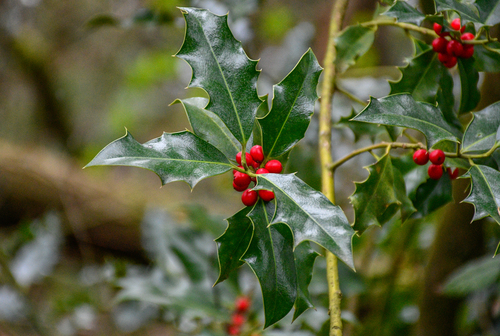
European holly
Ilex aquifolium
The European Holly is more than just a holiday symbol; it is a fortress of survival for backyard wildlife. This hardy evergreen provides critical winter food and impenetrable shelter when the rest of the forest goes bare.
Quick Identification
Size
Grows as a shrub or tree, reaching heights of 10–25 m (33–82 ft) with a trunk up to 40–80 cm (16–31 in) in diameter.
Colors
Glossy dark green upper leaves, paler matte green undersides, bright red berries (females only), and silver-grey bark.
Key Features
- Glossy, leathery leaves with sharp, wavy spines
- Bright red spherical berries (drupes) found on female plants
- Smooth, thin, silver-grey bark that stays even as it ages
- Small, fragrant four-petaled white flowers appearing in late spring
When You’ll See Them
Geographic range
Where Does the European holly Live?
European Holly is native to the temperate regions of Western and Southern Europe, stretching from the British Isles and coastal Norway down through the Mediterranean basin. Its natural territory extends into Northwest Africa and Southwest Asia, including parts of Turkey and Iran. While it is a beloved native in European forests, it has been introduced to North America and New Zealand, where it is often cultivated in gardens but can occasionally become invasive in moist, coastal woodland environments.
Basemap © OpenStreetMap contributors
Behavior
European Holly is a dioecious species, meaning individual trees are either male or female. This reproductive strategy requires both sexes to be present in an area for the female to produce its iconic red berries. While the tree grows slowly, it is incredibly long-lived and resilient, often thriving in the deep shade of oak and beech forests where other plants struggle. Its evergreen nature makes it a vital structural component of its ecosystem, providing year-round shelter.
In terms of wildlife interaction, the Holly acts as a high-energy cafeteria during the winter months. While the berries are toxic to humans, they are a critical food source for birds like Thrushes and Waxwings. Interestingly, the tree exhibits 'heterophylly,' where leaves higher up—out of reach of grazing animals—often lack the sharp spines found on the lower branches, a fascinating defense mechanism that adapts to its environment.
EverydayEarth exclusive
Camera Tips
To capture the best wildlife action around a European Holly, position your camera at 'berry height'—usually 4 to 6 feet off the ground—focusing on a dense cluster of fruit. This is where the most dramatic interactions occur, as Mistle Thrushes and Fieldfares are known to aggressively defend a single tree from other birds throughout the winter. A fast trigger speed is essential here to catch the quick fluttering of wings as birds dart in and out of the prickly foliage.
Don't overlook the base of the tree for your camera placement. The thick, evergreen canopy of a Holly creates a 'dry zone' and a natural umbrella during rain or snow. Position a camera low to the ground, angled toward the trunk, to capture mammals like Hedgehogs, Wood Mice, or even Foxes seeking shelter or foraging through the leaf litter for fallen berries and insects. This is an excellent spot for night-vision captures.
Be mindful of the Holly's high-gloss leaves, which can act like tiny mirrors. If you are using a camera with a powerful infrared flash, the 'hot spots' reflecting off the waxy leaves can wash out your image. To combat this, try to angle the camera at a 45-degree offset from the foliage rather than pointing it directly at the leaf faces, or use a piece of frosted tape over part of the flash to diffuse the light for a softer, more natural nocturnal scene.
Similar Species
Species that look similar or are commonly confused with European holly.
Frequently Asked Questions
Record European holly at your habitat
Connect a camera to start building your own species record — AI identifies every visitor automatically.