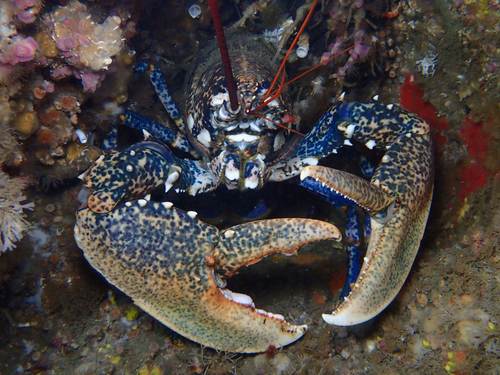
European lobster
Homarus gammarus
Meet the sapphire sentinel of the seabed. The European lobster is a master of the rocky Atlantic coast, famous for its stunning blue armor and impressive, bone-crushing claws.
Quick Identification
Size
Typically 25–50 cm (10–20 in) long, reaching up to 60 cm (24 in); weights range from 0.5 to 6 kg (1.1–13.2 lb).
Colors
Brilliant deep blue carapace with creamy-white or yellowish mottling; underside is pale; turns bright red only when cooked.
Key Features
- Massive, asymmetrical claws (one heavy 'crusher' and one sharper 'cutter')
- Vivid navy or electric blue coloration in life
- Smooth carapace with prominent rostrum and two pairs of long antennae
When You’ll See Them
Geographic range
Where Does the European lobster Live?
The European lobster is native to the eastern Atlantic Ocean, stretching from the arctic waters of northern Norway down to the warm Atlantic coast of Morocco. It is a common resident across the entirety of the British Isles and is frequently found throughout the Mediterranean Sea and parts of the western Black Sea. This species thrives in temperate waters and is strictly an Old World inhabitant, rarely overlapping with its American relative except in rare cases of accidental introduction.
Basemap © OpenStreetMap contributors
Behavior
European lobsters are solitary and highly territorial invertebrates that spend the majority of their daylight hours hidden within the safety of rocky crevices, tunnels, or under large boulders. They are primarily nocturnal, emerging under the cover of darkness to patrol the seabed for food. While they appear to crawl slowly on their four pairs of walking legs, they possess a powerful abdominal muscle that allows them to perform a 'tail-flip'—a rapid backward swim used to escape predators.
Socially, these lobsters are known for their complex mating rituals which typically occur in the summer months. Females carry the fertilized eggs (referred to as being 'berried') attached to their swimmerets for up to eleven months before they hatch into planktonic larvae. Although they have no natural interaction with humans in a domestic sense, they are a flagship species for marine conservation and a prized sighting for coastal snorkelers and divers.
EverydayEarth exclusive
Camera Tips
Capturing a European lobster on camera requires a specialized underwater setup, as they never leave the water. For coastal residents, the most effective 'backyard' method is to use a waterproof action camera, like a GoPro, inside a weighted dive housing. During a low spring tide, identify rocky gulleys or large boulders that remain submerged even at low water. Securely tether your camera to a heavy weight or a fixed rock to ensure the tide doesn't carry your gear away.
Because lobsters are nocturnal, lighting is your biggest challenge. Use an underwater video light with a red-light mode if possible; lobsters are less startled by red light than by harsh white LEDs. Position the camera facing a likely-looking crevice or 'hole' in the rocks. To increase your chances of a close-up, place a small mesh bag of oily bait—such as mackerel, sardines, or crushed shore crabs—directly in front of the lens, roughly 30 cm (12 in) away.
Set your camera to a time-lapse photo mode (one frame every 5-10 seconds) or use a high-capacity battery for a continuous 2-3 hour video soak starting just after sunset. The best results occur during the summer months when lobsters move into shallower, warmer waters to moult and feed more aggressively. Always check local weather and swell reports before deploying gear to ensure the water clarity is sufficient for a clear shot.
Similar Species
Species that look similar or are commonly confused with European lobster.
Frequently Asked Questions
Record European lobster at your habitat
Connect a camera to start building your own species record — AI identifies every visitor automatically.