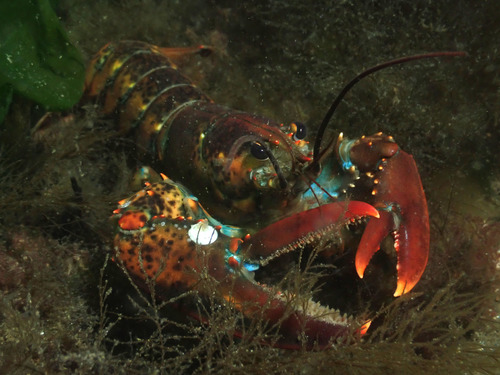
American Lobster
Homarus americanus
The heavyweight champion of the Atlantic coast, the American Lobster is a fascinating architect of the seafloor known for its massive claws and vibrant, mottled armor.
Quick Identification
Size
Body length up to 64 cm (25 in); weight can exceed 20 kg (44 lb)
Colors
Typically mottled bluish-green to dark brown with reddish spines; rare genetic variants can be bright blue, yellow, or calico
Key Features
- One massive crushing claw and one sharper cutting claw
- Four pairs of walking legs and two long antennae
- Segmented tail used for rapid backward swimming
- Red-tipped spines along the rostrum
When You’ll See Them
Geographic range
Where Does the American Lobster Live?
The American Lobster is native to the cold temperate waters of the Northwest Atlantic Ocean. Its primary range extends from the icy coastal waters of Labrador, Canada, south through the Gulf of Maine and down to the coastal shelf of New Jersey. While they are most densely populated in the rocky coastal areas of Maine and the Canadian Maritimes, smaller populations can be found as far south as Cape Hatteras, North Carolina, in deeper, cooler offshore waters.
Basemap © OpenStreetMap contributors
Behavior
The American Lobster is a solitary and territorial invertebrate that spends much of its life navigating the cold, rocky corridors of the Atlantic seafloor. While they appear slow-moving as they scavenge along the bottom, they are capable of incredible bursts of speed. By rapidly curling their muscular tails, they can shoot backward to escape predators like cod or seals, a movement known as 'tail flipping.'
These crustaceans are largely nocturnal, emerging from their rocky dens or muddy burrows under the cover of darkness to hunt. They are surprisingly social during mating periods but are otherwise known for their aggressive defense of their territory. Interestingly, lobsters do not have a centralized brain; instead, they possess a complex system of ganglia that allows them to process sensory information through their hairs and antennae, which are sensitive to both touch and chemicals in the water.
EverydayEarth exclusive
Camera Tips
Capturing an American Lobster on camera requires moving your gear underwater, but the results are incredibly rewarding. For coastal residents with docks or private waterfronts, a waterproof 'drop camera' or a rugged action camera (like a GoPro) mounted in a weighted housing is the best approach. Lower your camera near rocky structures or the base of pier pilings, as lobsters prefer these sheltered areas over open sandy bottoms. Position the lens to face a known crevice or 'den' entrance.
Lighting is the biggest challenge in underwater backyard photography. While lobsters are most active at night, bright white lights can startle them or cause them to retreat. Use a camera with a 'red light' night vision mode or attach a red filter to your external lights; lobsters have limited sensitivity to the red end of the spectrum and are less likely to flee. If you are using a tethered camera, look for 'live-feed' models that allow you to monitor the seafloor from your smartphone or laptop on the dock.
Baiting is a highly effective way to bring a lobster into the frame. Use a mesh bait bag filled with oily fish like herring or mackerel and secure it roughly 12 to 18 inches in front of the camera lens. This will not only attract lobsters from their burrows but will keep them occupied in the center of the frame as they attempt to access the food. Be patient; it may take an hour or more for a lobster to pick up the scent and venture out from its hiding spot.
Similar Species
Species that look similar or are commonly confused with American Lobster.
European Lobster
Found on the eastern side of the Atlantic; it lacks the spines on the underside of the rostrum (nose-like spike) that the American Lobster possesses.
Caribbean Spiny Lobster
Lacks the massive front claws of the American Lobster and has much longer, thicker antennae and a spiny carapace.
Frequently Asked Questions
Record American Lobster at your habitat
Connect a camera to start building your own species record — AI identifies every visitor automatically.