European Shag
Gulosus aristotelis
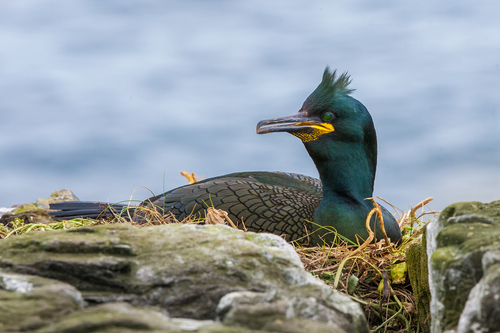
With their iridescent green plumage and striking emerald eyes, the European Shag is the sleekest diver of the rocky coast. These 'punk-rock' seabirds are famous for their recurved crests and their ability to plunge into the deep Atlantic surf.
Quick Identification
Size
Length: 65-80 cm (26-31 in); Wingspan: 90-105 cm (35-41 in); Weight: 1.5-2.2 kg (3.3-4.8 lbs)
Colors
Adults are glossy black with a distinct metallic green sheen. They feature a yellow gape at the base of the bill and striking emerald-green eyes. Immature birds are dark brown with paler underparts.
Key Features
- Recurved crest on the forehead during breeding season
- Slender, hooked bill with yellow skin at the base
- Bright emerald-green iris in adults
- Glossy dark-green plumage with a 'scaly' texture
When You’ll See Them
Geographic range
Where Does the European Shag Live?
Native to the eastern Atlantic and Mediterranean, the European Shag is found along the rocky fringes of Europe, North Africa, and Southwest Asia. Its core range includes the rugged coastlines of the United Kingdom, Norway, and Iceland, extending southward to the Iberian Peninsula and into the Mediterranean Sea. While most populations are resident year-round, birds from the northernmost reaches of Scandinavia may move slightly south to find ice-free waters during the winter months.
Basemap © OpenStreetMap contributors
Behavior
These birds are highly social during the breeding season, congregating in large, noisy colonies on rugged cliff ledges or tucked away in sea caves. While they are less prone to wing-drying than Great Cormorants, they are still frequently seen perched on wave-lashed rocks, holding their wings out to shed water after a long fishing session. They are strictly marine and are almost never found on inland freshwater bodies.
EverydayEarth exclusive
Camera Tips
To capture the European Shag on camera, you need to focus on their favorite 'drying stations'—the prominent, spray-lashed rocks just above the high-tide line. Position your camera at a low angle (about 1-2 feet off the ground) to capture their sleek profile against the ocean. Since these birds are strictly coastal, look for sheltered inlets or rocky piers where they regularly haul out to rest. Be sure to use a fast shutter speed or a high-frame-rate video setting, as their jump-dive happens in a flash.
Because they are active during the day, lighting is your best friend. The iridescent green sheen of their feathers is most visible in the golden hour light of early morning or late afternoon. Avoid using flash, which can startle them and wash out the subtle metallic textures of their plumage. If you are setting up a camera near a nesting colony on a cliff, ensure it is securely weighted or tethered; coastal winds and curious gulls can easily knock over lightweight equipment.
While Shags aren't attracted to traditional backyard bird feeders, if you have a property overlooking the sea, you can encourage them to stay in view by providing a sturdy, flat-topped piling or a large, stable rock that remains above water at high tide. In terms of camera settings, use a motion-sensitive trigger with a 'pre-roll' feature if possible, as this will help you catch the moment they land or begin their characteristic dive. During the spring, look for the 'crest'—their distinctive punk-rock tuft of feathers—which makes for a spectacular close-up shot.
Similar Species
Species that look similar or are commonly confused with European Shag.
Frequently Asked Questions
Record European Shag at your habitat
Connect a camera to start building your own species record — AI identifies every visitor automatically.