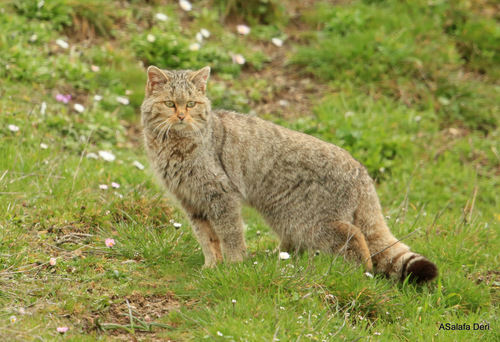
European Wildcat
Felis silvestris
The elusive 'Ghost of the Forest,' the European Wildcat is a master of disguise and solitude. Distinct from the common house cat, this fierce predator represents the untamed spirit of the European wilderness.
Quick Identification
Size
Head-to-body length of 45–65 cm (18–26 in) with a 21–35 cm (8–14 in) tail; weights typically range from 3–7.5 kg (6.6–16.5 lb).
Colors
Greyish-brown coat with distinct dark stripes on the neck and forehead; the tail is thick with 2-4 black rings and a solid, blunt black tip.
Key Features
- Thick, bushy tail with a blunt black tip
- Four or five longitudinal dark stripes on the neck
- Pink nose and long, white whiskers
- More robust build and longer legs than most domestic cats
When You’ll See Them
Geographic range
Where Does the European Wildcat Live?
Native to the European continent, the European Wildcat maintains a fragmented but wide distribution that stretches from the Scottish Highlands across to the Caucasus Mountains. It is most commonly found in the forested regions of Germany, France, the Iberian Peninsula, and the Balkans, with significant populations also residing in Turkey. While once nearly eradicated from many areas, conservation efforts and reintroduction programs are slowly helping them reclaim parts of their former range in Central and Western Europe.
Basemap © OpenStreetMap contributors
Behavior
The European Wildcat is a master of stealth and solitude. Unlike domestic cats, they are notoriously shy and go to great lengths to avoid human contact, making them one of the most difficult species to spot in the wild. They are strictly territorial, with males maintaining larger home ranges that overlap with several females. Communication is primarily handled through scent marking with urine and cheek-rubbing on trees, though they do possess a vocal range similar to domestic cats, albeit with a deeper, more resonant growl and hiss.
These felines are primarily crepuscular and nocturnal, timing their activity to match the peak movements of their prey. During the day, they rest in hidden dens located in hollow trees, rock crevices, or abandoned badger setts. While they are capable climbers, they prefer to hunt on the forest floor. In winter, they may become more active during daylight hours to conserve energy in the cold, though they generally avoid areas with deep snow cover which hinders their movement.
EverydayEarth exclusive
Camera Tips
Capturing a European Wildcat on camera requires patience and the right lure. These cats are highly sensitive to smells. The absolute best method to attract one is using valerian root—either in tincture form or as a dried herb. Rub the valerian on a rough wooden stake or a tree trunk at 'cat height' (about 30cm off the ground). The scent mimics feline pheromones and often induces a 'catnip' reaction, causing the wildcat to rub against the post, which allows for excellent identification shots.
Position your camera at knee-height (approximately 30-40 cm) to ensure you capture the profile of the animal. This is crucial for distinguishing them from domestic cats. You want to see the side of the body and, most importantly, the tail. Set your camera to take 'burst' photos or short 10-second videos. This helps you count the number of rings on the tail and check the bluntness of the tip, which are the primary ways to confirm a true wildcat sighting.
Place your cameras along 'pinch points'—natural bottlenecks in the landscape like narrow woodland paths, gaps in stone walls, or along the edges of dense thickets. Avoid placing cameras in wide-open fields, as wildcats prefer to stay near cover. If using night vision, ensure your camera has a 'no-glow' or 'low-glow' infrared flash, as these cats are extremely wary of artificial light and may avoid the area if they detect a bright red glow from the LEDs.
Check your cameras less frequently than usual—perhaps once every two weeks—to minimize human scent in the area. European Wildcats have an incredible sense of smell and will avoid a location if it smells too strongly of human activity. Using rubber gloves when handling your camera and setup can help mask your presence and increase your chances of a successful capture.
Similar Species
Species that look similar or are commonly confused with European Wildcat.
Domestic Cat
Domestic cats have a tapering tail with a pointed tip and come in a vast array of colors, whereas wildcats always have a blunt-tipped tail and a specific grey-brown tabby pattern.
African Wildcat
The African Wildcat is more slender with reddish-tinted ears and a more tapered tail; it is the direct ancestor of the domestic cat.
Frequently Asked Questions
Record European Wildcat at your habitat
Connect a camera to start building your own species record — AI identifies every visitor automatically.