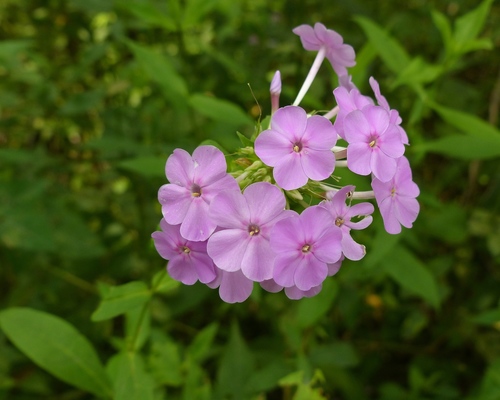
fall phlox
Phlox paniculata
A quintessential star of the summer garden, Fall Phlox offers vibrant clusters of fragrant blooms that act as a magnet for hummingbirds and butterflies. This hardy native perennial is a must-have for any wildlife enthusiast looking to bring color and life to their backyard.
Quick Identification
Size
60-120 cm (2-4 feet) tall; flower clusters 15-20 cm (6-8 inches) wide
Colors
Large clusters of pink, lavender, purple, or white flowers; deep green lance-shaped leaves
Key Features
- Large dome-shaped flower clusters (panicles)
- Five-petaled tubular flowers
- Opposite, lance-shaped leaves with prominent veins
- Height typically 3 to 5 feet
- Sweet, clove-like fragrance
When You’ll See Them
Geographic range
Where Does the fall phlox Live?
Native to the North American continent, fall phlox is primarily found across the eastern and central United States. Its core range extends from New York south to Georgia and west into states like Arkansas, Missouri, and Illinois. Because of its popularity as an ornamental plant, it has successfully established 'escaped' populations in the Pacific Northwest and parts of Canada, thriving in temperate climates with distinct seasons.
Basemap © OpenStreetMap contributors
Behavior
Fall phlox is a hardy perennial that serves as a cornerstone for the late-summer ecosystem. Unlike animals, its 'behavior' is defined by its growth cycle and its interaction with the local fauna. It begins as a cluster of sturdy stems that grow skyward throughout the spring, eventually crowned by dense, fragrant flower heads that bloom from mid-summer into early autumn. Its most notable trait is its powerful, honey-like fragrance, which becomes particularly intense in the late afternoon and evening to attract crepuscular pollinators.
In the wild and in gardens, fall phlox acts as a high-traffic social hub. It provides a landing platform and deep nectar wells for long-tongued insects that many other flowers cannot accommodate. While it is a peaceful resident of meadows and garden borders, it can be competitive for sunlight and is known for its resilience, often returning to the same spot for decades if the soil remains moist and fertile.
EverydayEarth exclusive
Camera Tips
Capturing the beauty of fall phlox with an AI-powered camera is less about catching 'movement' of the plant and more about documenting the incredible variety of pollinators it attracts. Position your camera on a tripod at 'flower-head' height—typically 3 to 4 feet off the ground—angled slightly downward to capture the flat faces of the blooms. This perspective is perfect for identifying visiting butterflies like Eastern Tiger Swallowtails or the fascinating Hummingbird Clearwing moth.
Because fall phlox is most attractive to wildlife during the sunniest parts of the day, ensure your camera is positioned to avoid direct lens flare, which can wash out the vibrant pinks and purples. If your camera has a 'time-lapse' mode, this is an excellent way to watch the panicles slowly open over a week in July. For the best AI triggers, set your motion sensitivity to high; the fast-moving wings of hummingbirds and moths are what you’re really looking to capture.
Seasonal timing is everything. Start your monitoring in mid-summer just as the first buds show color. If you are using a trail camera with close-focus capability, place it within 2-3 feet of a healthy cluster. This proximity allows the AI to better distinguish between different insect species. Keep the area around the base of the plant clear of tall grass so the camera's motion sensor isn't triggered by wind-blown weeds instead of the visiting wildlife.
Similar Species
Species that look similar or are commonly confused with fall phlox.
Frequently Asked Questions
Record fall phlox at your habitat
Connect a camera to start building your own species record — AI identifies every visitor automatically.