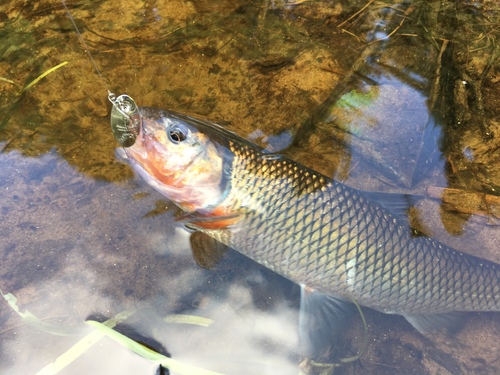
Fallfish
Semotilus corporalis
Meet the 'Silver Giant' of Eastern streams. The Fallfish is the largest native minnow in North America and a master underwater architect known for building massive stone nests.
Quick Identification
Size
Up to 50 cm (20 in) in length, though commonly 15-30 cm; weight up to 1.5 kg (3.3 lbs)
Colors
Bright silvery sides with a darker olive-green or bronze back; scales often have dark edges creating a diamond-like pattern
Key Features
- Largest native minnow in Eastern North America
- Silvery, mirror-like scales with dark crescent margins
- Deeply forked tail fin
- Large mouth reaching back to the front of the eye
When You’ll See Them
Geographic range
Where Does the Fallfish Live?
The Fallfish is native to the eastern regions of the North American continent, primarily inhabiting the Atlantic slope drainages. Its core range extends from the James River system in Virginia northward through the Mid-Atlantic and New England states into Eastern Canada, specifically Ontario, Quebec, and New Brunswick. While it is a staple of clear Appalachian streams, it has also established itself in various lake systems throughout the Northeast where water quality remains high.
Basemap © OpenStreetMap contributors
Behavior
Fallfish are energetic and highly active fish, often referred to as the 'shiners' of the stream because of how their scales catch the light. They are notable for their impressive engineering skills; during the spring spawning season, males become 'underwater architects,' painstakingly carrying thousands of stones in their mouths to build massive mound nests. These nests can reach over six feet in diameter and three feet in height, serving as a hub for aquatic life where other smaller fish species often 'hitchhike' and lay their own eggs alongside the Fallfish.
Outside of the breeding season, they are opportunistic and somewhat aggressive for their size. They are social creatures that frequently form loose schools, especially in deeper pools or under overhanging vegetation. While they are generally wary of humans, they are a favorite among light-tackle anglers because of their willingness to strike at both natural bait and artificial lures, often putting up a spirited fight that belies their status as a minnow.
EverydayEarth exclusive
Camera Tips
To capture the fascinating world of the Fallfish, focus your efforts on clear, shallow stream sections where you can see gravel or cobble on the bottom. If you have access to a backyard creek, the best time to deploy an underwater camera is during late spring (May and June). Look for large, mysterious piles of stones—these are the Fallfish nests. Positioning a waterproof trail camera on a weighted tripod or a flat rock facing these mounds will capture incredible footage of the males building and defending their territory.
Because Fallfish are highly visual, lighting is critical. Position your camera so that the morning or late afternoon sun illuminates the water column without creating a direct silhouette. If you are using a camera above the water line, a polarizing filter is essential to cut through the surface reflection and reveal the silvery flashes of the fish below. Set your camera to a high frame rate (60fps or higher) to capture their lightning-fast strikes at the surface.
While they are naturally curious, you can encourage Fallfish to linger in front of the lens by placing a small mesh bag of crushed worms or fish meal slightly upstream from the camera. The scent will draw the school into the frame. Ensure the camera is secured tightly; even though they are small, the current in their preferred habitats can be strong, and curious Fallfish have been known to poke at shiny camera lenses, potentially shifting the angle.
Similar Species
Species that look similar or are commonly confused with Fallfish.
Frequently Asked Questions
Record Fallfish at your habitat
Connect a camera to start building your own species record — AI identifies every visitor automatically.