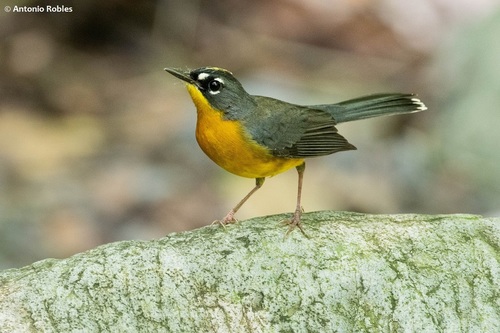
Fan-tailed Warbler
Euthlypis lachrymosa
A restless gem of the forest floor, the Fan-tailed Warbler captivates observers with its rhythmic tail-flicking and bright yellow plumage. Found along the Pacific slope from Mexico to Nicaragua, this energetic songbird is a master of the shaded undergrowth.
Quick Identification
Size
14.5–16 cm (5.8–6.3 in) in length; Weight approximately 12–18 g
Colors
Bright yellow underparts with a warm tawny wash on the chest; gray head with a black-framed yellow crown stripe; olive-gray upperparts and white undertail coverts.
Key Features
- Broad fan-shaped tail frequently flicked open
- Yellow crown patch bordered by thick black stripes
- Bold white crescents or 'broken' eye-ring
- Constant hopping and tail-fanning behavior
When You’ll See Them
Geographic range
Where Does the Fan-tailed Warbler Live?
This striking warbler is native to the Americas, primarily inhabiting the Pacific slope of the continent. Its core range stretches from the northern reaches of Mexico down through Central America to Nicaragua, where it favors hilly terrain and forest edges. While it is a permanent resident in these tropical regions, birders occasionally spot adventurous individuals as rare vagrants in the southwestern United States, specifically in Arizona, New Mexico, and Texas.
Basemap © OpenStreetMap contributors
Behavior
The Fan-tailed Warbler is a charismatic and energetic songbird that spends most of its life close to the earth. Unlike many of its relatives that flit through the canopy, this species is specialized for life in the forest understory and on the forest floor. It is best known for its habit of rhythmically spreading and flicking its long, white-tipped tail, a behavior intended to startle insects out of the leaf litter so they can be easily captured.
These birds are generally found in pairs or as solitary individuals, patrolling territories in shaded ravines and near rocky outcroppings. They are highly active and vocal, possessing a melodious, upslurred song that carries well through dense vegetation. While they can be shy around humans, they are bold in their environment, often ignoring larger animals as they focusedly hunt for prey among fallen leaves.
EverydayEarth exclusive
Camera Tips
To capture high-quality footage of the Fan-tailed Warbler, ground-level camera placement is essential. These birds are terrestrial foragers, so mounting your AI-powered camera 6 to 12 inches off the ground near a pile of leaf litter or at the base of a shaded ravine will yield the best results. Angle the lens slightly upward to capture the vibrant yellow of the throat and the distinctive crown markings.
Technical settings should prioritize a fast shutter speed or high-frame-rate video. Because this species is defined by its rapid tail-flicking and hopping movements, a standard camera may capture only a yellow blur. Setting your device to a 'burst' mode of 3-5 photos or short 10-second video clips will help you freeze the frame exactly when that magnificent tail is fully fanned out.
While they don't frequent traditional bird feeders, Fan-tailed Warblers are highly attracted to water, especially moving water. A low-profile bird bath with a solar-powered dripper or a small recirculating fountain in a shaded corner of your yard is the ultimate lure. Position your camera about 3-5 feet from the water source. Since they prefer darker, shaded environments, ensure your camera has a high-quality sensor that performs well in low-light conditions to avoid grainy footage.
Similar Species
Species that look similar or are commonly confused with Fan-tailed Warbler.
Frequently Asked Questions
Record Fan-tailed Warbler at your habitat
Connect a camera to start building your own species record — AI identifies every visitor automatically.