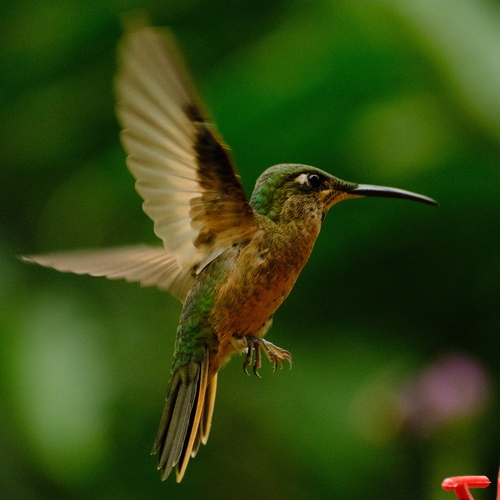
Fawn-breasted Brilliant
Heliodoxa rubinoides
A robust gem of the Andean cloud forests, the Fawn-breasted Brilliant is easily recognized by its warm cinnamon plumage and its rhythmic, traplining foraging habits. This high-altitude specialist is a frequent and welcome visitor to montane gardens across South America.
Quick Identification
Size
11–13 cm (4.3–5.1 in) in length; 7–9 g (0.25–0.32 oz) in weight
Colors
Metallic coppery-green upperparts, warm cinnamon or fawn-colored underparts, and a bright pinkish-red iridescent throat patch on males.
Key Features
- Warm cinnamon-buff underparts
- Pinkish-red iridescent throat patch (males)
- Large, robust hummingbird body
- Slightly decurved bill with a pinkish base
When You’ll See Them
Geographic range
Where Does the Fawn-breasted Brilliant Live?
This elegant hummingbird is a native of the South American Andes, where it finds its home in high-altitude cloud forests. Its range follows the mountain chain through Colombia, Ecuador, and Peru, reaching its southern limit in Bolivia. It is a specialist of the subtropical and temperate zones, rarely venturing far from the moist, moss-heavy environments of the mountain slopes.
Basemap © OpenStreetMap contributors
Behavior
The Fawn-breasted Brilliant is a relatively large and sturdy hummingbird that moves with more deliberation than many of its smaller, more erratic cousins. It is primarily a 'trapliner,' a foraging strategy where the bird follows a fixed route between widely dispersed flowering plants throughout the day. This behavior makes them predictable visitors to specific garden spots or feeders once they have established their territory.
While they can be territorial around a particularly rich nectar source, they are generally less aggressive than species like the Sparkling Violetear. In social interactions at feeders, they often occupy a middle-tier position, holding their own against smaller hummingbirds but deferring to larger montane species. They are mostly solitary, coming together only briefly for mating or when congregating at high-value food sources.
EverydayEarth exclusive
Camera Tips
To successfully capture the Fawn-breasted Brilliant on camera, you should focus your efforts on the mid-story of the forest or garden. These birds typically forage at heights between 4 and 10 feet from the ground. Position your camera about 5 feet high, aimed at a nectar feeder or a cluster of tubular flowers like Fuchsia or Centropogon. Using an AI-powered camera with a fast trigger speed is essential, as even a 'slower' hummingbird moves remarkably fast when approaching a flower.
Lighting is critical for identifying this species correctly. The male's iridescent pink throat patch and the coppery tones of the back often appear dark or black in the shade. To get the best results, place your camera in a spot that receives bright, indirect morning light. If the sun is behind the camera lens, it will illuminate the metallic feathers, revealing the 'brilliant' colors that give the genus its name. Avoid placing the camera where it will be backlit, which will turn the bird into a featureless silhouette.
Because the Fawn-breasted Brilliant is a trapliner, they are creatures of habit. If you capture a clip of one at 9:00 AM, there is a very high probability they will return to that same spot around the same time the following day. Use this to your advantage by fine-tuning your camera angle after the first sighting. Setting your camera to record 10-15 second video clips rather than still photos will give you a much better chance of observing the diagnostic fawn-colored belly and the subtle pink flash of the throat.
Similar Species
Species that look similar or are commonly confused with Fawn-breasted Brilliant.
Frequently Asked Questions
Record Fawn-breasted Brilliant at your habitat
Connect a camera to start building your own species record — AI identifies every visitor automatically.