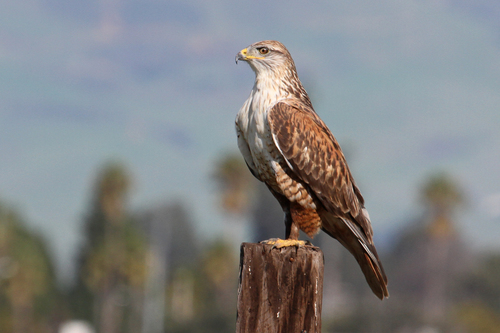
Ferruginous Hawk
Buteo regalis
As the largest Buteo in North America, the Ferruginous Hawk is a master of the western prairies. With its feathered legs and piercing gaze, it is one of the most magnificent raptors you can discover on the open range.
Quick Identification
Size
Length: 51–69 cm (20–27 in); Wingspan: 122–152 cm (48–60 in); Weight: 907–2,268 g (2.0–5.0 lbs)
Colors
Light morph features white underparts with rusty-red (ferruginous) legs and shoulders; dark morph is entirely chocolate brown or cinnamon.
Key Features
- Feathered legs all the way to the toes
- Bright yellow gape (mouth line) extending below the eye
- Distinctive 'V' shape formed by dark rufous legs against a white belly in flight
- Broad wings and a very large, heavy head
When You’ll See Them
Geographic range
Where Does the Ferruginous Hawk Live?
The Ferruginous Hawk is a true native of the North American West, thriving in the vast, open expanses from the Canadian prairies down through the Great Basin and Great Plains. Its core breeding range is centered in the United States and southern Canada, with significant populations found in states like Montana, Wyoming, and Utah. During the winter months, many individuals migrate southward into the southwestern United States and across the border into the arid highlands of northern Mexico.
Basemap © OpenStreetMap contributors
Behavior
The Ferruginous Hawk is a powerful and patient predator, often referred to as the 'eagle of the hawks' due to its sheer size and regal profile. Unlike many other hawks that prefer dense woodland, this species is a specialist of the open range. They are frequently observed standing on the ground near rodent burrows, waiting with incredible stillness for prey to emerge, or soaring high above the prairie on slightly upturned wings (dihedral).
These birds are notably sensitive to human activity, especially during the nesting season. While they are territorial and will vigorously defend their nests against intruders, they are prone to abandoning sites if disturbed too frequently by people or construction. In the backyard context, they are most likely to be seen in rural properties that border large tracts of grassland or sagebrush steppe.
EverydayEarth exclusive
Camera Tips
To capture a Ferruginous Hawk on camera, location is everything. Because they are birds of wide-open spaces, you should place your camera on a high-vantage point if available, such as a lone fence post, a T-post in a pasture, or a rocky outcrop. These hawks love to survey their territory from a 'sentinel' position. Mount your camera about 4 to 5 feet high, angled slightly upward if the post is a known perch, or level with the ground if you are targeting a known hunting area near rodent burrows.
Using a PIR (Passive Infrared) sensor is effective, but because these hawks often sit still for long periods, consider using a time-lapse mode during the peak morning and late afternoon hunting hours. This ensures you catch them even if they aren't moving enough to trigger the motion sensor. If your backyard is large and rural, placing the camera near a water stock tank can be highly effective, as these large raptors will frequently visit for a drink in arid environments.
Since Ferruginous Hawks are easily spooked, ensure your camera is well-camouflaged and avoid checking it too frequently. In the winter, they are more likely to scavenge, so placing the camera near naturally occurring carcasses (in a safe, legal manner) can provide stunning close-ups. Set your trigger speed to the fastest possible setting (0.2s - 0.5s) to capture the moment they take flight, as their wingspan is so large they can exit the frame in a split second.
Similar Species
Species that look similar or are commonly confused with Ferruginous Hawk.
Rough-legged Hawk
Smaller with a much smaller bill and gape; typically has a dark belly band and a dark terminal tail band.
Red-tailed Hawk
Lacks feathered legs; light morphs usually have a distinct 'belly band' of dark streaks and a reddish tail.
Golden Eagle
Significantly larger; adults are uniformly dark brown with a golden nape, lacking the white underparts of a light-morph Ferruginous Hawk.
Frequently Asked Questions
Record Ferruginous Hawk at your habitat
Connect a camera to start building your own species record — AI identifies every visitor automatically.