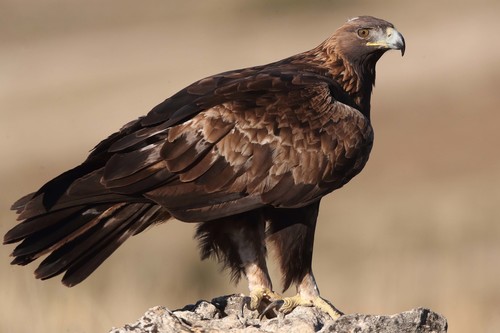
Golden Eagle
Aquila chrysaetos
Commanding the crags and canyons of the Northern Hemisphere, the Golden Eagle is a symbol of wild power. With its massive wingspan and piercing gaze, this apex predator is the ultimate discovery for any backyard explorer.
Quick Identification
Size
Length: 66–102 cm (26–40 in); Wingspan: 1.8–2.34 m (5.9–7.7 ft); Weight: 3–6.7 kg (6.6–14.7 lbs)
Colors
Adults are primarily dark brown with distinctive golden-buff feathers on the crown and nape. Juveniles are darker and possess white patches at the wing joints and a white tail base with a black terminal band.
Key Features
- Golden-brown feathers on the nape of the neck
- Fully feathered legs down to the toes
- Massive, dark-hooked bill with a yellow base (cere)
- Broad wings held in a slight 'V' shape when soaring
When You’ll See Them
Sightings on EverydayEarth
Jul 29, 2026
On a dry, golden hillside in Big Sur, a group of California Condors is gathered near a release structure. Among them, a Golden Eagle is particularly active, hopping across the ground and spreading its wings. The birds appear to be congregated around a carcass or feeding site. The scene concludes with the camera panning to the left, revealing the expansive, rugged terrain and forested canyons of the sanctuary.
Jul 29, 2026
A group of California Condors is gathered at a carcass in a dry, rocky clearing. In the center of the activity, a Golden Eagle is actively feeding while the condors, several of which have visible identification tags on their wings, stand nearby and watch.
Jul 22, 2026
The scene begins with several dark birds congregating around a stone water trough. The camera then pans to reveal a Golden Eagle standing over a carcass in the dry grass. The eagle remains alert, turning its head to survey the surroundings while guarding its meal as evening shadows lengthen across the hillside.
Jul 22, 2026
In the bright morning sun, a Golden Eagle and several Common Ravens are observed scavenging from a carcass on the ground. The eagle's distinctive golden nape is clearly visible as it feeds. The camera then cuts to a wider view of the sanctuary habitat, showing multiple California Condors perched on rocks and near a flight pen structure, surveyed the dry hillside.
May 27, 2026
A Golden Eagle is perched on a rocky outcrop in an open field, scanning the surrounding hillside. The bird remains alert, turning its head several times and shifting its weight while looking toward the research building in the background.
May 14, 2026
Two California Condors and a Golden Eagle are gathered on a dry, grassy hillside. On the left, the Golden Eagle is hunched over and actively feeding on a carcass. In the center and right, two condors stand watch; the individual on the far right is wearing a prominent yellow wing tag with the code 'A3'.
Geographic range
Where Does the Golden Eagle Live?
The Golden Eagle is the most widely distributed eagle species in the world, claiming a massive footprint across the Northern Hemisphere. In North America, they are most prevalent in the western regions from Alaska through the United States to central Mexico, though they also range across Europe, North Africa, and the vast landscapes of Asia from Siberia to Japan. They are typically found in wild, remote areas where high cliffs provide safe nesting sites overlooking expansive hunting grounds.
Basemap © OpenStreetMap contributors
Behavior
Golden Eagles are masters of the sky, known for their incredible aerial agility and high-speed hunting dives. They are primarily solitary or found in bonded pairs, maintaining massive home territories that they defend vigorously. Unlike many other raptors, they are relatively shy and prefer remote areas far from human disturbance, often spending hours perching on high cliffs or soaring on thermal updrafts to scan for movement below.
These eagles are monogamous and famous for their spectacular courtship displays, which include 'sky-dancing'—a series of deep, rhythmic swoops and vertical dives. They are highly intelligent hunters that have been known to cooperate with their mates to flush out and trap prey. While they are generally quiet, they may communicate with thin, high-pitched whistles during the nesting season.
EverydayEarth exclusive
Camera Tips
To capture a Golden Eagle on a backyard or trail camera, you must focus on 'vantage point' placement. These birds rarely land on the ground in flat areas unless they are feeding. If your property has a high ridge, a lone tall tree, or a sturdy fence post overlooking a valley, that is your prime location. Mount your camera at least 5-6 feet high, angled slightly upward to capture the eagle as it perches or takes flight. Because they are wary of human scents and objects, use a camouflaged camera housing and minimize your visits to the site.
In winter, Golden Eagles are much more likely to be seen at lower elevations as they search for food. If it is legal and safe in your area, placing a camera near a natural food source—like a fallen deer in a remote field—is the most reliable way to get close-up shots. Use 'Burst Mode' or high-frame-rate video settings. Golden Eagles move with explosive speed when they land or strike, and a standard single-shot trigger often results in a photo of an empty sky or a blurry tail feather.
Light is critical for showing off their namesake golden nape. Position your camera so it faces North or South to avoid the harsh backlighting of the sun. The late afternoon 'golden hour' provides the perfect spectrum to illuminate the buff-colored feathers on their head. If you are using an AI-triggered camera like those from EverydayEarth, ensure your motion sensitivity is set to high; while eagles are large, their silent, gliding approach might not trigger low-sensitivity sensors until it is too late.
Similar Species
Species that look similar or are commonly confused with Golden Eagle.
Bald Eagle
Adults have white heads and tails; immatures have unfeathered lower legs and more mottled white under the entire wing rather than distinct patches.
Turkey Vulture
Much smaller head, rocks unsteadily in flight, and holds wings in a much deeper 'V' shape than the steady Golden Eagle.
Ferruginous Hawk
Also has feathered legs, but is smaller with a lighter underside and distinctive rust-colored feathers on the legs and shoulders.
Frequently Asked Questions
Record Golden Eagle at your habitat
Connect a camera to start building your own species record — AI identifies every visitor automatically.