Fish Crow
Corvus ossifragus
The clever, nasal-voiced cousin of the American Crow, this wetland specialist is a master of the shoreline and a rising star in suburban backyards across the East Coast.
Quick Identification
Size
Length: 36-41 cm (14-16 in); Wingspan: 76-91 cm (30-36 in); Weight: 195-330 g (6.9-11.6 oz)
Colors
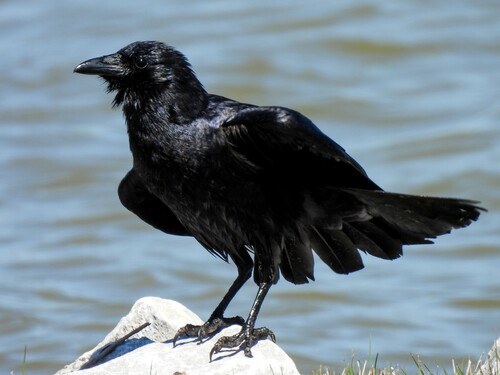
Entirely black with a high-gloss violet or blue-green sheen; eyes, beak, and legs are also black
Key Features
- Distinctive nasal 'uh-uh' or 'aw' call
- Slender bill and more tapered wings than American Crow
- Smaller, more delicate build compared to other crows
- Glossy plumage with a blue or green iridescent tint
When You’ll See Them
Geographic range
Where Does the Fish Crow Live?
Native to the North American continent, the Fish Crow is a characteristic species of the Eastern and Southeastern United States. Its core range hugs the Atlantic coastline from southern Maine down through the Florida peninsula and stretches westward along the Gulf Coast into eastern Texas. In recent decades, these adaptable birds have expanded their territory inland, following major river systems like the Mississippi, Ohio, and Potomac into the heart of the Mid-Atlantic and Midwest states.
Basemap © OpenStreetMap contributors
Behavior
The Fish Crow is a highly social and intelligent member of the corvid family, known primarily for its distinctive, nasal vocalizations. While they often congregate in large flocks, especially during the winter months, they are more specialized than their more common cousins, keeping a close affinity for water. They are frequent visitors to coastal marshes, riverbanks, and increasingly, suburban environments where they exhibit a bold yet cautious curiosity toward human activity.
These birds are opportunistic foragers and master problem-solvers. In social settings, they are less aggressive than American Crows but are quite vocal, often engaging in 'conversations' within the flock. They have been observed using teamwork to harass larger predators away from food sources and are known to follow other fish-eating birds, like gulls or ospreys, to scavenge leftovers or even steal catches mid-air.
EverydayEarth exclusive
Camera Tips
To capture the Fish Crow on a backyard camera, placement is everything. Since these birds are highly attracted to water, placing your camera near a large, elevated birdbath or a backyard pond will yield the best results. They prefer to land on a high vantage point before descending, so if you can angle your camera toward a flat fence rail or a sturdy branch overlooking a feeding station, you’ll catch their characteristic 'scouting' behavior.
Exposure is the biggest challenge when filming Fish Crows due to their deep black plumage. Position your camera so the sun is behind it (facing north or south) to avoid silhouettes and to capture the beautiful violet and green iridescent sheen of their feathers. If your AI camera has adjustable exposure settings, try bumping the exposure compensation up slightly (+0.3 or +0.7) to bring out the detail in their dark feathers without washing out the background.
For baiting, Fish Crows are particularly fond of unsalted peanuts in the shell and suet. However, because they are opportunistic, they may also be attracted to shiny objects or scraps. If you are using a trail camera, placing it near a shoreline or a riverbank at a height of about 3 to 5 feet will capture them as they forage for aquatic delicacies. Early morning is their peak activity time, so ensure your camera's batteries are fresh for the dawn chorus when they are most active and vocal.
Similar Species
Species that look similar or are commonly confused with Fish Crow.
Frequently Asked Questions
Record Fish Crow at your habitat
Connect a camera to start building your own species record — AI identifies every visitor automatically.