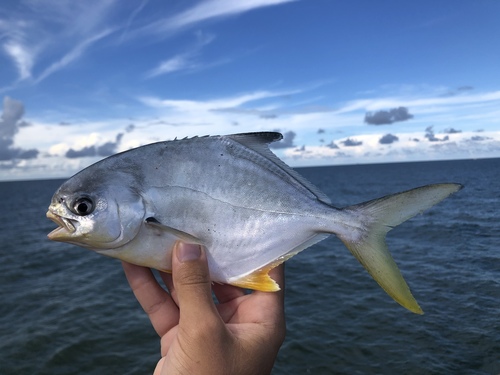
Florida Pompano
Trachinotus carolinus
A shimmering silver icon of the Atlantic coast, the Florida Pompano is a master of the surf. Watch these fast-moving beauties as they navigate the tides and forage along the sandy shorelines.
Quick Identification
Size
Typically 12–17 inches (30–43 cm) and 1–3 lbs (0.45–1.4 kg); maximum up to 26 inches (66 cm) and 9 lbs (4.1 kg)
Colors
Metallic blue-green or silvery dorsal side; bright silver body with distinct buttery yellow on the belly and fins
Key Features
- Deeply compressed, oval-shaped body profile
- Short, blunt snout with a small, toothless mouth
- Deeply forked tail (caudal fin)
- Lack of dark vertical bars on the sides
When You’ll See Them
Geographic range
Where Does the Florida Pompano Live?
The Florida Pompano is a quintessential species of the Western Atlantic, natively ranging from the coast of Massachusetts all the way down to Brazil. They are most abundant in the warm, subtropical waters of the Gulf of Mexico and around the Florida peninsula, where they serve as a staple of the coastal ecosystem. These fish are highly migratory, moving northward along the Atlantic coast during the summer months and returning to the tropical warmth of Florida and the Caribbean as winter approaches.
Basemap © OpenStreetMap contributors
Behavior
Florida Pompano are high-energy, schooling fish known for their incredible speed and agility. They are most commonly found in the 'swash zone'—the turbulent area where waves break against the shore. They utilize this rough water to disorient their prey and hide from larger predators. Social by nature, they typically travel in small to medium-sized groups, moving rhythmically with the tides to stay in optimal feeding grounds.
In coastal backyard settings, such as salt-water canals or tidal creeks, Pompano are known for their 'skipping' behavior. When spooked by a boat or a larger fish, they may leap from the water and skip across the surface. While they are generally wary of human activity, they are frequently seen around docks and piers where light attracts the small crustaceans they enjoy eating.
EverydayEarth exclusive
Camera Tips
To capture Florida Pompano on an AI-powered camera, you will need a waterproof underwater housing or a specialized dock camera. Position your camera near the bottom of a dock piling or along the sandy edge of a seawall, as Pompano are 'bottom feeders' that spend most of their time looking down for movement in the sand. Aim the lens horizontally across the sand-line to catch them as they cruise for mole crabs.
Timing is everything with this species. Set your camera to record during the two hours before and after high tide. Pompano use the rising water to reach previously dry sand where coquina clams and sand fleas are buried. If your camera setup allows for it, placing a mesh bait bag filled with crushed shrimp or clam shells just outside the frame can create a 'scent trail' that encourages a school to linger in front of the lens instead of swimming quickly past.
Because Pompano are extremely fast swimmers, use a high frame rate (at least 60 fps) to avoid motion blur. Their silver scales are highly reflective, so avoid using direct artificial white light at night, which can 'wash out' the image. Natural morning sunlight reflecting off a sandy bottom provides the best contrast for the AI to identify their distinct oval shape and yellow fins. During the spring migration, look for clearer water days, as heavy surf can kick up silt that obscures the camera's view.
Similar Species
Species that look similar or are commonly confused with Florida Pompano.
Frequently Asked Questions
Record Florida Pompano at your habitat
Connect a camera to start building your own species record — AI identifies every visitor automatically.