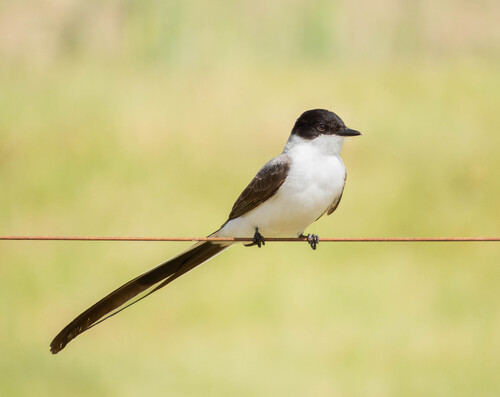
Fork-tailed Flycatcher
Tyrannus savana
A master of the skies with a tail that defies gravity, the Fork-tailed Flycatcher is one of the most elegant visitors to the American savannas. Known for its daring aerial acrobatics, this bird turns every insect hunt into a spectacular performance.
Quick Identification
Size
Length: 28–41 cm (11–16 in) including tail; Wingspan: 36–42 cm (14–16.5 in); Weight: 28–32 g
Colors
Striking jet-black head and face mask contrast with a pale gray back and snow-white underparts. The long, deeply forked tail is black with white outer feathers.
Key Features
- Extremely long, deeply forked black tail feathers
- Solid black crown and face mask
- Clean white throat and belly
- Pale gray upperparts
When You’ll See Them
Geographic range
Where Does the Fork-tailed Flycatcher Live?
Native to the Americas, the Fork-tailed Flycatcher occupies a vast range stretching from southern Mexico through Central America and across most of South America to central Argentina. While northern populations are year-round residents, the southern populations are famous for their long-distance migrations, often wandering as 'vagrants' as far north as the United States and even Canada during the fall. They are most commonly found in open, sunny habitats rather than dense forests.
Basemap © OpenStreetMap contributors
Behavior
The Fork-tailed Flycatcher is a bold and conspicuous bird, often seen perched on high, exposed branches, fence lines, or utility wires. From these vantage points, they scan the area for flying insects. When they spot prey, they launch into a high-speed aerial chase, using their long, scissor-like tail as a rudder to perform incredibly sharp turns and acrobatic maneuvers. This 'sallying' behavior is a hallmark of the tyrant flycatcher family.
These birds are highly territorial during the breeding season and are known for their fearlessness, often chasing away much larger hawks or crows that venture too close to their nesting sites. While they are solitary hunters, during migration periods, they can be seen in loose flocks of dozens or even hundreds, especially when moving through South America. Their presence in a backyard or field is usually announced by their active, restless energy and occasional dry, clicking vocalizations.
EverydayEarth exclusive
Camera Tips
To capture the Fork-tailed Flycatcher on camera, you must focus on their perching habits. These birds are 'sallying' hunters, meaning they return to the same exposed branch or fence post repeatedly after catching an insect. Position your camera 5 to 8 feet off the ground, aimed horizontally at a prominent, isolated perch like a dead branch or a wooden fence post overlooking an open lawn or field.
Because they are not attracted to seed or suet, your best bet for a backyard 'lure' is a water feature. A birdbath with a solar-powered dripper or a small fountain is highly attractive to them for bathing and drinking, especially in the heat of the afternoon. If you have native berry-producing shrubs (like Pokeberry or various palms), position a camera nearby during the late summer and fall when their diet shifts toward fruit for migration energy.
Lighting and shutter speed are critical for this species. Their fast movements and long tails can easily cause motion blur. Ensure your camera is in a well-lit area to allow for the fastest possible exposure. Use 'Burst Mode' or high-speed photo settings if available; this will help you capture the moment they spread their magnificent tail feathers during takeoff or landing. Early morning light from 7:00 AM to 9:00 AM provides the best contrast for their black-and-white plumage.
Similar Species
Species that look similar or are commonly confused with Fork-tailed Flycatcher.
Frequently Asked Questions
Record Fork-tailed Flycatcher at your habitat
Connect a camera to start building your own species record — AI identifies every visitor automatically.