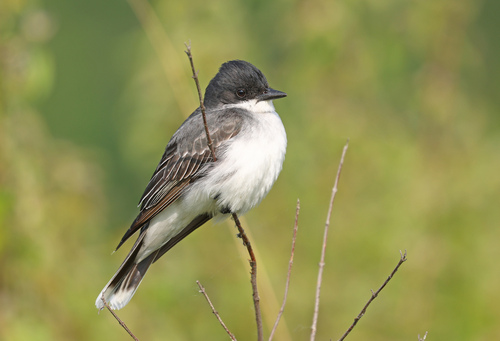
Eastern Kingbird
Tyrannus tyrannus
Meet the 'tyrant' of the backyard—a sleek, monochromatic flycatcher known for its fearless attitude and remarkable aerial acrobatics. With its sharp white-tipped tail and bold personality, the Eastern Kingbird is a captivating sight for any nature enthusiast.
Quick Identification
Size
Length: 19–23 cm (7.5–9 in); Wingspan: 33–38 cm (13–15 in); Weight: 33–55 g (1.2–1.9 oz)
Colors
Slaty-black upperparts and head with clean, snow-white underparts; dark tail featuring a prominent white terminal band. Sexes are identical.
Key Features
- Distinctive white band at the tip of the tail
- Slaty-black 'business suit' coloring with a white throat and belly
- Large, somewhat blocky head with a hidden red crown patch
- Upright, alert perching posture on fence lines or branches
When You’ll See Them
Geographic range
Where Does the Eastern Kingbird Live?
Native to North America, the Eastern Kingbird boasts an expansive breeding range that stretches from the Gulf of Mexico all the way north into central Canada and across most of the United States, excluding the arid Southwest. This long-distance traveler undergoes an impressive annual migration, crossing through Central America to spend the non-breeding season in the tropical forests and river basins of South America, particularly in the Amazon region. They are highly adaptable to human-altered landscapes, provided there are open spaces for hunting and scattered trees for nesting.
Basemap © OpenStreetMap contributors
Behavior
Eastern Kingbirds are famous for their fearless, assertive nature, often seen 'mobbing' much larger predators like hawks, crows, and even Great Blue Herons that venture too close to their nesting sites. They are quintessential tyrant flycatchers, perching prominently on fence lines or low branches and sallying out to snatch insects mid-air with an audible snap of their beaks. Despite their name, they aren't royalty, but their commanding presence and 'wait-and-watch' hunting style certainly suggest it.
While highly territorial during the summer breeding season in North America, their social structure shifts dramatically during the winter. Once they migrate to South America, they become much more social, gathering in large flocks to forage for fruit in the Amazon basin. In backyard settings, they are conspicuous and loud, often letting out a series of buzzy, electric-sounding 'zeer' calls from their favorite high-visibility perches.
EverydayEarth exclusive
Camera Tips
To capture the Eastern Kingbird on camera, focus your efforts on their favorite 'sallying' perches. These birds are creatures of habit and will return to the same exposed branch, fence post, or wire repeatedly to scan for insects. Place your AI-powered camera 5 to 10 feet away from an isolated, sunlit perch at an elevation of 4 to 6 feet. Avoid pointing the camera directly into the sun; instead, position it so the morning or evening light illuminates the bird's white chest, which provides a beautiful contrast against the dark background.
While kingbirds won't visit traditional seed feeders, you can entice them into your camera’s field of view by providing a clean, shallow birdbath. They are particularly attracted to moving water, so adding a solar-powered dripper or fountain can make your yard a destination for them to drink and bathe. Since these birds are highly active during the day, set your camera to a fast shutter speed or 'action' mode to avoid motion blur when they take flight to snatch a passing fly.
The best time to record high-quality footage is during the peak of summer (June and July) when they are actively feeding hungry nestlings. During this time, their activity levels skyrocket. If you have an orchard or a garden with native fruit-bearing shrubs like elderberry or serviceberry, positioning a camera near these bushes in late summer can capture their transition from an insect-heavy diet to fruit-eating before they begin their long journey south.
Similar Species
Species that look similar or are commonly confused with Eastern Kingbird.
Eastern Phoebe
Smaller with brownish-gray upperparts; lacks the white tail tip and frequently pumps its tail while perching.
Western Kingbird
Similar shape and behavior, but features a bright yellow belly and lacks the broad white band at the tip of the tail.
Loggerhead Shrike
Similar gray and white palette but features a distinct thick black mask through the eyes and a heavy, hooked beak.
Frequently Asked Questions
Record Eastern Kingbird at your habitat
Connect a camera to start building your own species record — AI identifies every visitor automatically.