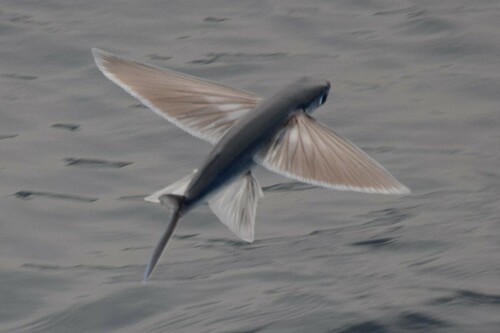
Fourwing Flyingfish
Hirundichthys affinis
The Fourwing Flyingfish is a true ocean acrobat, famous for its ability to launch itself from the waves and glide for hundreds of feet. This iridescent blue traveler is a symbol of the Caribbean and a marvel of high-speed marine evolution.
Quick Identification
Size
Typically ranges from 20 to 30 cm (8 to 12 inches) in length; weight is generally between 0.5 and 1.1 lbs.
Colors
Dorsal side is a vibrant iridescent dark blue or greenish-blue; ventral side (belly) is a stark silvery-white. Pectoral fins are mostly dark with a translucent trailing edge.
Key Features
- Large pectoral and pelvic fins that function as four 'wings'
- Deeply forked tail with a significantly longer lower lobe
- Sleek, cylindrical body optimized for high-speed aquatic flight
When You’ll See Them
Geographic range
Where Does the Fourwing Flyingfish Live?
The Fourwing Flyingfish is native to the tropical and subtropical waters of the Atlantic Ocean. Its primary range extends from the mid-Atlantic United States and the Gulf of Mexico through the Caribbean Sea down to the coastal waters of southern Brazil. Across the ocean, it is also commonly found along the western coast of Africa, particularly from Senegal to Angola, thriving in warm, high-salinity currents.
Basemap © OpenStreetMap contributors
Behavior
The Fourwing Flyingfish is a marvel of marine evolution, best known for its ability to leap from the water and glide for long distances to evade predators like tuna, dolphins, and marlin. By beating its tail rapidly—up to 50 times per second—against the water's surface, it generates enough lift to remain airborne. Once in the air, it spreads its large pectoral and pelvic fins to catch the wind, often covering distances of over 200 meters in a single glide.
These fish are highly social and are typically found in large schools. They are pelagic, meaning they live in the open ocean, but they frequently move closer to shore to spawn. During spawning, they search for floating debris or mats of sargassum seaweed to attach their sticky, thread-like eggs. They are also notably phototactic, meaning they are naturally drawn to light sources at night, a behavior often utilized by local fishermen and researchers.
EverydayEarth exclusive
Camera Tips
Capturing the Fourwing Flyingfish on camera requires a specialized approach since they are marine animals. If you have a property with a pier, dock, or ocean-facing balcony, mount your camera at a height of 5 to 10 feet above the water line, angled slightly downward toward the horizon. Use a fast shutter speed (at least 1/2000 sec) to freeze the motion of their rapid tail vibrations and gliding 'wings' during a breach from the waves.
To attract these fish to your camera’s field of view at night, use a submersible or surface-mounted LED light. Fourwing Flyingfish are naturally attracted to light sources, which often leads them to leap toward boats or docks. Positioning a light so it illuminates a patch of water approximately 10 to 20 feet from your camera will create a 'stage' where they are likely to congregate or leap. For daytime shots, a circular polarizing filter is essential to cut through the sun's glare on the water's surface, allowing the camera to track the fish just before they break the surface.
Since these fish move at speeds of up to 35 mph (56 km/h), traditional motion triggers on trail cameras may be too slow. Instead, use a camera with a 'pre-roll' or 'high-speed video' function. If you are using an AI-powered camera like those featured on EverydayEarth, ensure it is set to 'continuous burst' mode or high-frame-rate video. During the peak spawning months—typically December through June—look for floating mats of sargassum seaweed or even floating debris, as flyingfish often gather near these to lay their eggs, providing a consistent spot for focused camera placement.
Similar Species
Species that look similar or are commonly confused with Fourwing Flyingfish.
Frequently Asked Questions
Record Fourwing Flyingfish at your habitat
Connect a camera to start building your own species record — AI identifies every visitor automatically.