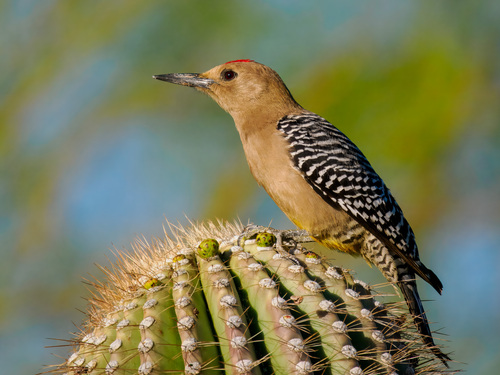
Gila Woodpecker
Melanerpes uropygialis
The spirited architect of the desert, the Gila Woodpecker is as famous for its bold personality as it is for its iconic zebra-striped back. Whether they are excavating Saguaro nests or visiting backyard feeders, these birds are the vibrant heartbeat of the American Southwest.
Quick Identification
Size
8.7–9.4 in (22–24 cm) long; 15.7–16.5 in (40–42 cm) wingspan; 1.8–2.8 oz (51–79 g)
Colors
Tan-to-grayish head and underparts; black and white zebra-striped back, wings, and tail. Males have a small red circular patch on the crown; females and juveniles lack the red.
Key Features
- Zebra-striped 'ladder' pattern on back and wings
- Plain tan-buff face and belly
- Small red cap on the center of the male's head
- White wing patches visible only in flight
When You’ll See Them
Geographic range
Where Does the Gila Woodpecker Live?
The Gila Woodpecker is a quintessential desert dweller of North America, primarily native to the Sonoran Desert ecosystem. Its core range extends across southern Arizona, southeastern California, the southern tip of Nevada, and southwestern New Mexico, reaching down through the Mexican states of Sonora, Sinaloa, and the Baja California peninsula. These birds are permanent residents within their territory, meaning they do not migrate and can be spotted in the same backyard year-round if food and water are available.
Basemap © OpenStreetMap contributors
Behavior
The Gila Woodpecker is a boisterous and highly vocal presence in the desert, often heard before it is seen. Known for its sharp 'yip' calls and rolling 'churr' sounds, this species is a master architect, excavating deep nesting cavities in Saguaro cacti. These cavities, known as 'boots,' provide essential shelter for the woodpeckers and, once abandoned, serve as vital nesting sites for owls, flycatchers, and even honeybees. They are remarkably bold birds that have adapted seamlessly to human presence, frequently exploring suburban eaves and backyards.
In the wild, they are territorial and will aggressively defend their nests or food sources from much larger birds. Their social structure is largely centered around the pair bond during the breeding season, but they are often seen in loose association near reliable food sources. Interestingly, Gila Woodpeckers are incredibly resourceful; they have been observed tapping on metal chimneys or streetlights to amplify their drumming sounds when claiming territory, proving that they are as clever as they are loud.
EverydayEarth exclusive
Camera Tips
To capture the best footage of Gila Woodpeckers, focus your camera on high-traffic 'hubs' such as suet feeders or water features. In the arid desert environment, a dripping birdbath or a solar-powered fountain is an absolute magnet for these birds. Position your camera at eye-level with the water source, roughly 3 to 5 feet away, to capture their characteristic head-bobbing and drinking behavior. If you have a Saguaro cactus with visible nesting holes, aim your camera upward toward the cavity, but ensure you aren't blocking their flight path.
Gila Woodpeckers are surprisingly fond of sugary treats. You can lure them into a perfect frame by offering orange halves or specialized woodpecker suet blocks containing nuts and berries. If you use a trail camera, set it to 'burst mode' or high-frame-rate video. Woodpecker movements are extremely fast and jerky; a standard single-photo trigger often results in a shot of a disappearing tail. High-speed video will allow you to see the incredible mechanics of their long, barbed tongues as they lick nectar from hummingbird feeders—a common backyard behavior for this species.
Lighting is your biggest challenge in the desert sun. Try to position your camera facing North or South to avoid the harsh backlighting of the rising or setting sun, which can wash out the intricate zebra-striping on the bird's back. Because Gila Woodpeckers are active during the hottest parts of the day, ensure your camera is placed in a shaded spot or under a protective housing to prevent the electronics from overheating and to keep the image sensor from blowing out the highlights on the bird's tan feathers.
Similar Species
Species that look similar or are commonly confused with Gila Woodpecker.
Ladder-backed Woodpecker
Smaller with a striped face and spotted breast; the Gila Woodpecker has a plain tan face and solid tan underparts.
Northern Flicker
Larger with a black 'bib' on the chest and spotted belly; the Gila lacks the bib and has a much more prominent zebra-stripe pattern on the back.
Frequently Asked Questions
Record Gila Woodpecker at your habitat
Connect a camera to start building your own species record — AI identifies every visitor automatically.