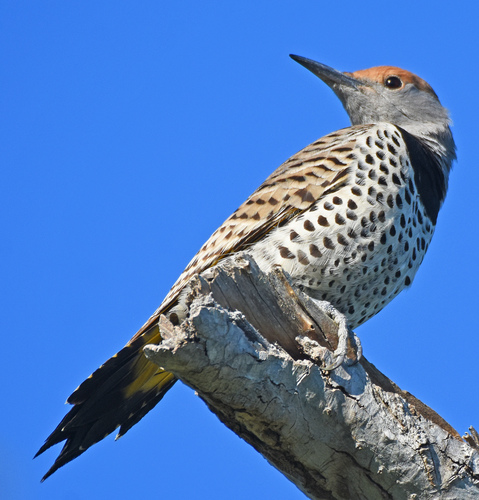
Gilded Flicker
Colaptes chrysoides
The golden-winged architect of the Sonoran Desert, the Gilded Flicker is a striking woodpecker that makes its home in the heart of giant cacti.
Quick Identification
Size
Length: 28–31 cm (11–12 in); Wingspan: 48–53 cm (19–21 in); Weight: 92–115 g (3.2–4.1 oz)
Colors
Tan-brown back with black bars; gray face and neck; cinnamon crown. Underparts are white to tan with bold black spots and a large black crescent on the chest. Males feature a red malar (mustache) stripe.
Key Features
- Bright yellow underwings and tail shafts visible in flight
- Large white rump patch
- Male has a red mustache stripe, female has none
- Gray face contrasting with a cinnamon-brown crown
When You’ll See Them
Geographic range
Where Does the Gilded Flicker Live?
The Gilded Flicker is a resident of the North American desert southwest, rarely wandering far from its specialized habitat. Its native range is anchored in the Sonoran Desert, spanning southern Arizona, the southeastern tip of California, and the southernmost point of Nevada. Moving south into Mexico, it is found throughout the Baja California peninsula and much of the state of Sonora, making it a true icon of the international borderlands.
Basemap © OpenStreetMap contributors
Behavior
The Gilded Flicker is a unique member of the woodpecker family that has perfectly adapted to life in the arid Southwest. Unlike many other woodpeckers that spend most of their time hammering on trees, the Gilded Flicker is frequently seen on the ground. They are specialized ant-eaters, using their long, slightly curved bills and sticky tongues to lap up thousands of insects from desert soil. Their flight is characteristic of woodpeckers—an undulating, heavy-flapping pattern that reveals a stunning flash of golden-yellow under the wings.
Socially, they are prominent vocalists in the desert morning. Their loud, rhythmic 'wick-wick-wick' calls can be heard from a distance, along with a piercing, single-note 'kyeer' call. They are primary cavity nesters, meaning they excavate their own homes, most famously in giant Saguaro cacti. These holes are vital to the desert ecosystem, as they later provide shelter for owls, flycatchers, and honeybees once the flickers move on.
EverydayEarth exclusive
Camera Tips
To capture the Gilded Flicker on camera, focus on ground-level activity. Because these birds spend a significant amount of time foraging for ants, a trail camera placed 12 to 18 inches off the ground near an active ant mound or a patch of bare, sandy soil will yield excellent results. Use a wide-angle setting if available, as they can be quite large and active when hopping across the desert floor.
Water is a massive draw in the arid Southwest. Placing your camera near a low-profile bird bath or a dripping water feature is one of the most effective ways to see them. Gilded Flickers are larger than many backyard birds, so ensure your camera is angled to capture a bird that stands nearly a foot tall. They are most active in the early morning hours just after sunrise, so ensure your camera's trigger speed is set to its fastest setting to catch them before they take flight.
If you have a Saguaro cactus on your property with visible nesting holes, aim your camera upward toward the cavity. These birds are very territorial and active around their nest sites from late February through June. Avoid using bright white-light flashes at night near nest sites; instead, rely on high-quality infrared or natural light during their daytime peak hours to avoid disturbing their breeding cycle.
Similar Species
Species that look similar or are commonly confused with Gilded Flicker.
Frequently Asked Questions
Record Gilded Flicker at your habitat
Connect a camera to start building your own species record — AI identifies every visitor automatically.