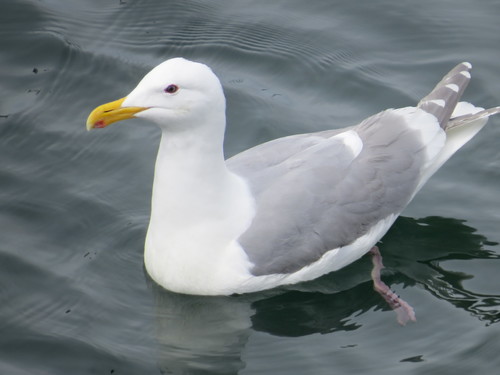
Glaucous-winged Gull
Larus glaucescens
Meet the undisputed king of the Pacific Northwest coast. With its pearly grey wings and bold personality, the Glaucous-winged Gull is a master of both the rugged shoreline and the urban landscape.
Quick Identification
Size
Length 50–68 cm (20–27 in), wingspan 120–150 cm (47–59 in), weight 730–1,690 g (1.6–3.7 lbs)
Colors
White head and underparts; pale pearl-grey back and wings; grey wingtips matching the back color; pink legs; yellow bill with a red spot.
Key Features
- Grey wingtips that match the color of the back (no black)
- Large, heavy yellow bill with a red spot on the lower mandible
- Pink legs and feet
- Stocky, powerful build with a blocky head shape
When You’ll See Them
Geographic range
Where Does the Glaucous-winged Gull Live?
The Glaucous-winged Gull is the definitive coastal gull of the North Pacific. Its native range hugs the coastline from the Aleutian Islands of Alaska down through British Columbia to the shores of Washington and Oregon. While they are year-round residents in the Pacific Northwest, some populations move south in the winter, reaching the coastal regions of California and even Baja California, Mexico. They are rarely found far inland, strictly adhering to the maritime influence of the Pacific coast.
Basemap © OpenStreetMap contributors
Behavior
Glaucous-winged Gulls are highly social and intelligent birds, often seen in large, noisy colonies. They are masters of the Pacific Northwest shoreline, where they exhibit a mix of wild foraging and bold urban scavenging. These gulls are well-known for their 'drop-catch' behavior, where they fly high with a clam or mussel and drop it onto hard rocks to crack the shell, repeating the process until they can reach the meat inside.
In human-populated areas, they are opportunistic and assertive, frequently patrolling docks, parking lots, and outdoor eateries for scraps. They communicate through a complex series of calls, including the 'long call' used to establish territory and the 'mew call' used during courtship or when leading chicks. Despite their reputation as 'trash birds' in cities, they are devoted parents and form long-term pair bonds, often returning to the same nesting site year after year.
EverydayEarth exclusive
Camera Tips
To capture high-quality footage of Glaucous-winged Gulls, your best bet is to focus on their water-related behaviors. These birds frequently seek out fresh water to bathe and drink, even when living on the ocean. Placing a low-profile camera near a large, shallow birdbath or a backyard pond will yield excellent results. Use a wide-angle lens to capture the dramatic splashing and wing-flapping that occurs during their bathing rituals.
Because gulls have bright white plumage, they can easily become 'blown out' or overexposed in bright sunlight, looking like a white blob on camera. To combat this, position your camera so the sun is behind it, or set the exposure compensation to -0.7 or -1.0. Early morning and late afternoon 'golden hour' light provides the best contrast to show off the subtle grey variations in their wings and the details of their pale eyes.
Gulls are large and fast. Set your camera to a fast trigger speed (0.2s or less) and use a high-frame-rate video setting (at least 60fps) if you want to capture clear movement. If your camera has a burst mode for photos, enable it; this is the only way to reliably catch the 'long call'—the iconic pose where they throw their heads back and open their mouths wide. Be sure to secure your camera firmly, as these gulls are curious and have powerful bills that can easily knock over a tripod or peck at a loose strap.
Similar Species
Species that look similar or are commonly confused with Glaucous-winged Gull.
Frequently Asked Questions
Record Glaucous-winged Gull at your habitat
Connect a camera to start building your own species record — AI identifies every visitor automatically.