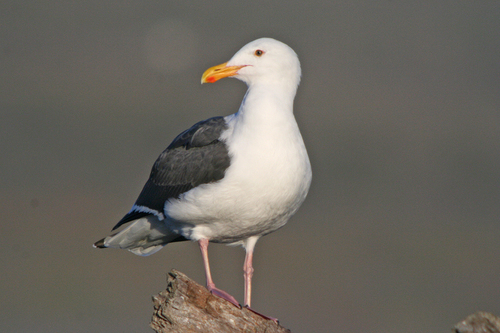
Western Gull
Larus occidentalis
The charismatic king of the West Coast shoreline, the Western Gull is a master of adaptation and a constant companion to the Pacific tides.
Quick Identification
Size
Length: 22-26 in (56-66 cm); Wingspan: 47-57 in (120-144 cm); Weight: 1.8-3.2 lbs (800-1,450 g)
Colors
Deep slate-gray back and wings (mantle), brilliant white head and underparts, yellow bill with a red spot on the lower mandible, and distinct pink legs.
Key Features
- Heavy, bulbous yellow bill with a red spot
- Dark slate-gray upperparts with black wingtips
- Stout pink legs and feet
- Large, powerful build compared to most other coastal gulls
When You’ll See Them
Sightings on EverydayEarth
Jul 29, 2026
In a sunny enclosure at the Aquarium of the Pacific, a Western Gull stands alert at the edge of a pool. In the background, several Magellanic Penguins are resting; two are perched on high rocks while a third sits on a wooden ramp. The water in the pool ripples gently.
Jul 29, 2026
A Western Gull is perched on the rocky edge of the enclosure, looking out over the water. Another bird is visible resting on a dark mat further back on the shore.
Jul 27, 2026
A Western Gull is perched on a stone ledge near the water's edge, occasionally turning its head. In the background, a small colony of Magellanic Penguins is visible, with individuals standing or resting on the various rocky tiers and ledges of their habitat.
Jul 27, 2026
Several Magellanic Penguins are resting and shifting positions on a rocky shoreline. In the foreground, a Western Gull swims steadily across the water from right to left.
Jul 26, 2026
A Western Gull is perched on the rocky bank overlooking the water. In the pool, several penguins are visible swimming and diving through the clear water, with several individuals appearing from the left side of the frame.
Jul 23, 2026
A Western Gull perches on the rocky edge of a pool, looking into the water and occasionally dipping its bill down. In the background, a group of Magellanic Penguins are resting on a pebbled beach area and near a dark ramp, with some individuals shifting their positions in the sun.
Behavior
Western Gulls are the undisputed bosses of the Pacific shoreline. These are highly intelligent and opportunistic birds that have adapted remarkably well to human presence. While they are often seen scavenging at piers or beaches, they are also skilled hunters, capable of taking fish from the surface of the ocean or raiding the nests of other seabirds for eggs and chicks.
Socially, they are quite complex and territorial, especially during the nesting season. You will often hear their loud, laughing 'kyow' calls as they defend their space or communicate with mates. They are known for 'kleptoparasitism,' a behavior where they aggressively harass other birds to drop their catch, proving that they are as much pirates as they are predators.
EverydayEarth exclusive
Camera Tips
Capturing the Western Gull on a backyard or trail camera requires a bit of coastal strategy. If you live near the water, the best placement for your AI camera is on an elevated surface like a deck railing, a dock post, or even a flat rooftop. These birds prefer high vantage points where they can scan for food and potential threats. Position your camera about 3 to 5 feet off the ground, angled slightly upward if they are landing on a perch, or level if you are capturing them on a flat surface like a pier or patio.
Because Western Gulls have bright white feathers, they can easily 'blow out' or appear as a featureless white blob in direct, midday sun. To get the best detail in their plumage, try to face your camera North or South to avoid direct lens flare. Capturing them during the 'golden hours'—shortly after sunrise or before sunset—will provide softer lighting that highlights the texture of their feathers and the deep gray of their wings. If your camera allows for exposure adjustments, lowering the exposure compensation slightly can help keep those white highlights from overexposing.
To attract them for a photo, you don't necessarily need bait, as they are naturally curious. However, a shallow, sturdy birdbath or a flat stone surface can pique their interest. If you are in an area where it is appropriate to do so, placing a few fish trimmings or even a shiny object can bring them right in front of the lens. Be aware that they are bold birds, so you can set your trigger sensitivity to medium; they aren't easily spooked by the movement or mechanical sounds of a camera.
During the winter months, look out for 'first-year' gulls which are mottled brown and look like a completely different species. Using a high-speed burst mode is essential for gulls, as their most interesting behaviors—like the 'long call' display where they throw their heads back, or the moment they stretch their massive wings—happen in quick succession. A fast trigger speed will help you freeze the action of a landing or a territorial dispute between two birds.
Similar Species
Species that look similar or are commonly confused with Western Gull.
Frequently Asked Questions
Record Western Gull at your habitat
Connect a camera to start building your own species record — AI identifies every visitor automatically.