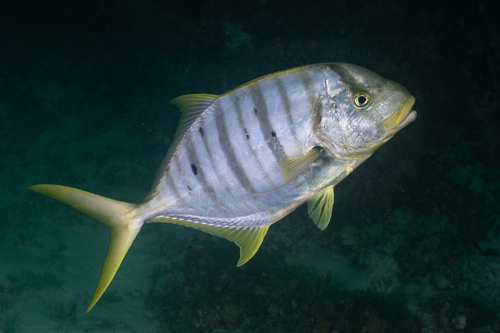
Golden Trevally
Gnathanodon speciosus
With its brilliant gold scales and bold personality, the Golden Trevally is the 'pilot' of the Pacific. Known for following sharks and divers alike, this stunning fish is a master of the reef's sandy floor.
Quick Identification
Size
Grows up to 120 cm (47 in) in length and can weigh up to 15 kg (33 lb)
Colors
Juveniles are brilliant yellow with thick black vertical bars; adults transition to a shimmering silvery-gold with faint dark patches or bars
Key Features
- Distinctive fleshy, rubbery lips
- Protractile jaws that extend downward
- Deeply forked caudal fin
- 7 to 11 black vertical bars on juveniles
When You’ll See Them
Geographic range
Where Does the Golden Trevally Live?
The Golden Trevally is a wide-ranging resident of the Indo-Pacific, spanning a massive territory from the eastern coast of Africa and the Red Sea all the way to the western shores of Central America. This species is particularly abundant in the tropical waters surrounding Australia, the Indonesian archipelago, and the various island chains of the South Pacific. While they are primarily found in the warm waters of the tropics, their range extends as far north as the Ryukyu Islands of Japan and as far south as the northern coast of New Zealand.
Basemap © OpenStreetMap contributors
Behavior
The Golden Trevally is one of the most charismatic members of the jack family, known for its unique 'piloting' behavior. As juveniles, these fish are famous for swimming inches away from the bodies of much larger marine animals, such as sharks, rays, and even sea turtles. This provides them protection from predators while allowing them to scavenge leftovers. This bold curiosity often extends to human divers and underwater cameras, which they may follow for long distances.
As they mature, Golden Trevallys become more independent but remain highly social, often forming small schools or hunting alongside other predatory fish. Their feeding method is fascinating to watch: they use their highly mobile, protractile mouths to create a vacuum, sucking up sand and debris from the seafloor to filter out small prey. This 'rooting' behavior often leaves visible pits in the sandy substrate of lagoons and reefs.
EverydayEarth exclusive
Camera Tips
Capturing the Golden Trevally on a backyard underwater camera requires a setup near a dock, pier, or reef edge where the water remains relatively clear. Because these fish are attracted to 'piloting' larger objects, your camera housing itself may act as a lure. Positioning the camera at a slight upward angle against the sunlight can highlight the stunning metallic gold scales of the adults, but ensure you use a polarizing filter if possible to reduce the glare from the water's surface.
If you are using a stationary trail-style underwater camera, place it near sandy patches adjacent to reef structures. You can encourage a Golden Trevally to visit by safely disturbing the sand in front of the lens right after setup; the cloud of debris mimics the activity of a foraging animal, which often brings these fish in to investigate for easy prey. They are highly visual hunters, so motion-activated recording works best during the bright mid-morning hours when their yellow and gold pigments are most vibrant.
For those with dock-mounted cameras, night recording with a gentle green or blue LED light can capture their nocturnal social behaviors. Avoid harsh white lights, which can spook them. During the day, keep the camera about 1 to 2 feet off the seabed to capture their unique vacuum-feeding action. If you catch a juvenile on camera, look for 'hitching' behavior where they may be swimming in the slipstream of a larger fish or even your camera's tether cable.
Similar Species
Species that look similar or are commonly confused with Golden Trevally.
Frequently Asked Questions
Record Golden Trevally at your habitat
Connect a camera to start building your own species record — AI identifies every visitor automatically.