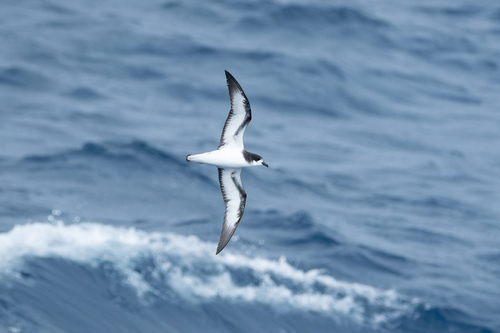
Gould's Petrel
Pterodroma leucoptera
A rare gem of the Pacific, Gould's Petrel is a resilient seabird that survives against the odds on remote island slopes and across thousands of miles of open ocean.
Quick Identification
Size
25–30 cm (10–12 in) length; 70–75 cm (27–30 in) wingspan; 180–200 g (6.3–7.1 oz)
Colors
Slate-grey to blackish hood and collar, white forehead and underparts, grey wings with a dark 'M' pattern
Key Features
- Distinct dark hood contrasting with a bright white forehead
- Small size with a long, thin tail
- Dark 'M' pattern across the upper wings in flight
- Pure white underwings with thin dark margins
When You’ll See Them
Geographic range
Where Does the Gould's Petrel Live?
Native to the Southwestern Pacific, Gould's Petrel is one of Australia's rarest seabirds, with its primary breeding grounds located on a few tiny islands off the coast of New South Wales, most notably Cabbage Tree Island. A second subspecies nests in the high-altitude forests of New Caledonia. During the non-breeding season, these birds are true wanderers, migrating across the vast expanse of the Central and Eastern Pacific Ocean, occasionally reaching as far as the waters off the South American coast.
Basemap © OpenStreetMap contributors
Behavior
Gould's Petrel is a master of the open ocean, spending the vast majority of its life far from land. As a member of the 'gadfly petrel' group, it is known for its erratic, high-speed flight, often arcing high above the waves before swooping down into the troughs. They are highly pelagic, meaning they only return to solid ground to breed, and even then, they are strictly nocturnal on land to avoid predators like gulls and sea eagles.
During the breeding season, these birds exhibit fascinating social behaviors at their colonies. They nest in rock crevices or among fallen leaves and rock scree, where they are known for their 'chattering' calls from the ground. While they are generally shy and elusive around humans, their survival is closely linked to conservation efforts on their specific nesting islands, where they have shown resilience when invasive predators are removed.
EverydayEarth exclusive
Camera Tips
Capturing Gould's Petrel on camera is a specialized task because they are only on land during the breeding season and only move under the cover of total darkness. If you are lucky enough to live near or visit a managed nesting site, focus your camera placement near burrow entrances or identified rock crevices. Position the camera low to the ground, roughly 12-18 inches high, angled slightly downward to catch the birds as they land and shuffle toward their nests.
Because these birds are extremely sensitive to light, you must use a camera with 'No-Glow' or 'Black' Infrared (IR) LEDs. Traditional white flashes or even 'Low-Glow' red LEDs can disorient the birds or attract predators to the nesting site. Set your camera to take short video clips (10-15 seconds) rather than just photos, as their movements on land can be erratic and a video is more likely to capture their distinctive 'waddling' gait.
In terms of settings, a high-sensitivity PIR (passive infrared) sensor is vital because these birds are relatively small and move quickly. Since they are active in the darkest hours, ensure your camera has a high-quality night sensor. Avoid using any baits or lures, as Gould's Petrels are not attracted to food on land; instead, rely on the natural traffic patterns near their nesting cavities during the peak months of November through March.
Similar Species
Species that look similar or are commonly confused with Gould's Petrel.
Frequently Asked Questions
Record Gould's Petrel at your habitat
Connect a camera to start building your own species record — AI identifies every visitor automatically.