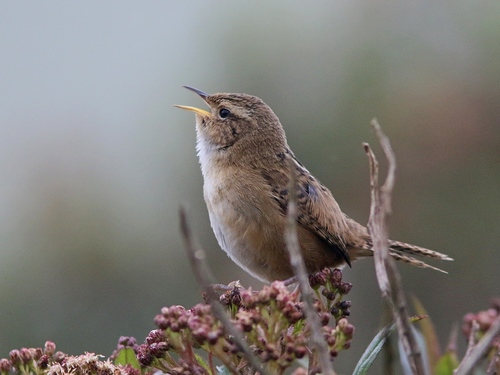
Grass Wren
Cistothorus platensis
The master of the tall grass, the Grass Wren is a tiny, streaked powerhouse known for its mechanical, rattling song and secretive, mouse-like movements. Discover the bird that turns every meadow into a concert hall.
Quick Identification
Size
Length: 9.5-11 cm (3.7-4.3 in); Weight: 7-10 g (0.25-0.35 oz)
Colors
Upperparts are warm brown with heavy black and white vertical streaking; underparts are pale buff or whitish; wings and tail are finely barred with dark brown.
Key Features
- Intricate black and white streaking on the crown and back
- Short, rounded wings and a small tail often held upright
- Pale buff-colored 'eyebrow' stripe (supercilium)
- Small, thin bill adapted for insect-eating
When You’ll See Them
Geographic range
Where Does the Grass Wren Live?
The Grass Wren is native to the Americas, claiming an enormous range that stretches from the highlands of Mexico through Central America and down to the southernmost tip of South America. It is most densely populated in the temperate pampas of Argentina, the high Andean grasslands of Peru and Colombia, and the coastal lowlands of Chile. While mostly sedentary in tropical regions, the southernmost populations are known to migrate northward toward Brazil and Uruguay during the cold austral winter months.
Basemap © OpenStreetMap contributors
Behavior
The Grass Wren is a secretive and mouse-like bird that prefers to stay hidden within thick, tall vegetation. Unlike many songbirds that fly over obstacles, the Grass Wren often scurries through the 'tunnels' formed by matted grass, making it difficult to spot even when it is calling just a few feet away. They are highly territorial, and males are famous for building multiple 'dummy' or 'cock' nests—unlined grass domes—throughout their territory to deter predators or provide choices for a mate.
While they are shy and visual sightings are often fleeting, their personality is revealed through their song. They are incredibly vocal, especially during the early morning hours, delivering a dry, rattling series of notes that can be heard across wide-open fields. When they do emerge, it is usually to perch briefly on the tip of a tall grass stalk or shrub to sing before diving back into the safety of the undergrowth. They are not particularly bold around humans but will tolerate suburban life if there is enough unmaintained grassland nearby.
EverydayEarth exclusive
Camera Tips
To successfully capture a Grass Wren on your AI camera, you must think low. These birds spend 90% of their time within a foot of the ground. Place your camera on a ground stake or a very short tripod, ideally no more than 12-18 inches high. Aim the lens at a 'natural stage'—a break in the tall grass, a flat rock, or a sturdy weed that stands slightly higher than the surrounding cover, as males will use these as temporary podiums for singing.
Standard bird feeders rarely attract this species because they are strict insectivores. Instead, focus on water and natural cover. A ground-level bird bath or a very shallow, dripping water feature placed near a tall grass boundary is an excellent lure. Position the camera 3-5 feet from the water source to ensure the small bird fills enough of the frame for the AI to trigger. Because they move with a fast, jerky, mouse-like gait, set your camera to 'Burst Mode' or high-speed video to avoid capturing nothing but a blurry tail.
Lighting is your biggest challenge in tall grass habitats. If the camera is placed deep in the grass, the shadows can confuse the sensor. Try to position your setup so the morning sun hits the 'stage' you've chosen. This highlights the intricate white streaking on their backs, which is their most diagnostic feature. If your camera allows for it, increase the motion sensitivity to its highest setting, as these birds weigh less than a AAA battery and may not always trigger less sensitive PIR sensors.
Lastly, pay attention to the wind. In a grassland environment, blowing stalks can cause hundreds of false triggers. Use your camera’s 'detection zone' feature to mask out the upper half of the frame where grass heads are swaying, focusing the trigger area only on the solid ground or the specific perch you are monitoring. Late spring is the best time for activity, as the birds are frantically gathering insects to feed their young in their hidden dome nests.
Similar Species
Species that look similar or are commonly confused with Grass Wren.
Frequently Asked Questions
Record Grass Wren at your habitat
Connect a camera to start building your own species record — AI identifies every visitor automatically.