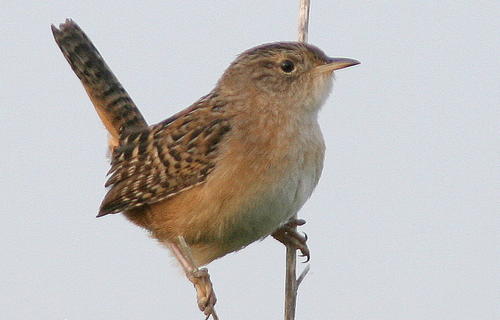
Sedge Wren
Cistothorus stellaris
The Sedge Wren is a tiny, streaked marvel of the wet prairie, known for its secretive nature and machine-gun chatter. A master of the 'hide-and-seek' lifestyle, this nomadic traveler brings a wild, unscripted energy to any tallgrass backyard.
Quick Identification
Size
Length: 4-4.7 in (10-12 cm); Wingspan: 4.7-5.9 in (12-15 cm); Weight: 0.2-0.4 oz (7-10 g)
Colors
Buffy-brown overall with fine white and black streaks on the crown and back; pale underparts with a warm ochre wash on the flanks; indistinct pale eyebrow.
Key Features
- Fine white streaks on a dark crown and back
- Short, often cocked tail with dark barring
- Pale, buffy chest without heavy spotting
- Small, thin bill adapted for insects
When You’ll See Them
Behavior
The Sedge Wren is one of the most elusive and nomadic songbirds in North America. Unlike many birds that return to the exact same nesting site every year, Sedge Wrens are famously opportunistic, often shifting their breeding grounds mid-season based on moisture levels and grass height. They move through tall vegetation with mouse-like agility, hopping between stalks rather than flying long distances. Because they stay low in dense cover, you are far more likely to hear their staccato, machine-gun-like chattering before you ever see a feather.
In terms of social behavior, they are highly territorial during the breeding season. Males will often build several "dummy nests"—unlined cock-nests made of woven grasses—within their territory to confuse predators or perhaps impress potential mates. While they are generally shy around humans, they can be bold when defending their patch of meadow, singing vibrantly from the top of a tall sedge stalk before diving back into the safety of the thatch.
EverydayEarth exclusive
Camera Tips
Capturing a Sedge Wren on camera requires a strategic approach because they rarely fly into the open. To increase your chances, place your camera very low to the ground—no higher than 12 to 18 inches. Aim the lens toward a small natural clearing in tall grass or at the base of a clump of sedges where the birds tend to forage. If your camera has a 'macro' or close-focus setting, enable it, as these birds are small and you will want high-detail shots from a short distance.
Because Sedge Wrens are incredibly fast and erratic in their movements, use a camera with a high trigger speed (0.2 seconds or less) and set it to take a burst of 3-5 photos. This ensures that even if the bird is just 'mousing' through the frame, you catch at least one clear image. If your device supports video, short 10-second clips are often better than photos for identifying their quick, jerky movements. Avoid using heavy baits; instead, focus on providing a small, shallow water source or a very low-profile birdbath near the grass edge, which can lure them out of the dense cover during hot afternoons.
Seasonal timing is critical. In many regions, Sedge Wrens don't arrive or start singing until July or August when the grass is at its tallest. Position your camera near the tops of prominent singing perches—like a single tall goldenrod stem or a sturdy willow branch sticking out of the grass. Early morning light is your best friend here, as the birds are most active then and the low sun angle will highlight the fine white streaking on their backs, making for a truly professional-grade wildlife shot.
Similar Species
Species that look similar or are commonly confused with Sedge Wren.
Frequently Asked Questions
Record Sedge Wren at your habitat
Connect a camera to start building your own species record — AI identifies every visitor automatically.