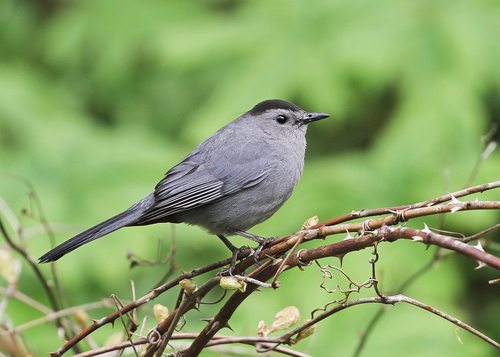
Gray Catbird
Dumetella carolinensis
The Gray Catbird is the elusive 'mewing' master of the garden thicket. With its sophisticated gray plumage and incredible gift for mimicry, this intelligent visitor is a highlight of any backyard birdwatcher's season.
Quick Identification
Size
8.3-9.4 inches (21-24 cm) long; wingspan of 8.7-11.8 inches (22-30 cm); weighs 0.8-2.0 oz (23-56 g)
Colors
Uniform slate gray body, black cap, black tail, and a signature chestnut-colored patch under the base of the tail.
Key Features
- Distinctive black cap
- Slate-gray plumage
- Rufous (chestnut) undertail coverts
- Long, rounded black tail
- Straight, dark bill
When You’ll See Them
Sightings on EverydayEarth
Jul 27, 2026
A busy scene at the feeder station features several species. Two female or immature Red-winged Blackbirds forage in the main seed tray, while a male Red-winged Blackbird perches on a nearby tube feeder showing his red epaulets. In the background, a Gray Catbird is perched prominently on a wooden support. Towards the end of the clip, a male Brown-headed Cowbird flies in and lands on the central support structure.
Jul 26, 2026
The feeder station is very active with multiple species. A male Downy Woodpecker feeds steadily on suet while several male and female Red-winged Blackbirds occupy the seed tray and tube feeders. A Blue Jay and a Gray Catbird make quick, high-energy visits to the station, landing briefly before departing.
Jul 13, 2026
A female Downy Woodpecker is perched on the central suet feeder, industriously pecking at the contents. In the background, a Gray Catbird moves behind a tube feeder, occasionally showing its long tail and dark cap. On the far right, a male House Finch feeds from within the protective cage of a hopper feeder.
Jul 4, 2026
A male Red-bellied Woodpecker is perched on the leftmost suet feeder, feeding throughout the duration of the clip. Initially, a Gray Catbird is visible on the sunflower seed feeder before it flies away to the right. Later, a female Red-winged Blackbird flies into the frame and lands in the tray feeder to forage for seeds.
Jun 13, 2026
A busy scene at the feeder station features several birds feeding simultaneously. An adult European Starling with iridescent, spotted plumage feeds on a suet block on the left, while a duller brown juvenile starling stands on the center tray, looking around. On the right, a Gray Catbird is perched on a seed tube, displaying its slate-gray body and dark cap.
Jun 9, 2026
A busy morning at the feeder station features a Blue Jay clinging to the suet cage on the left, while a Gray Catbird forages on the central platform. A Common Grackle briefly joins the scene, landing on the right side of the tray to search for seeds.
Geographic range
Where Does the Gray Catbird Live?
Native to the North American continent, the Gray Catbird is a widespread species that breeds across the eastern and central United States and southern Canada. During the autumn, these birds undertake a significant migration to their wintering grounds in the coastal southeastern United States, Mexico, Central America, and the Caribbean islands. This makes them a seasonal favorite for backyard birders across the temperate regions of the North, while they remain a common sight in tropical scrub during the winter months.
Basemap © OpenStreetMap contributors
Behavior
Gray Catbirds are famous for being the vocal mimics of the shrubbery. Closely related to mockingbirds and thrashers, they can string together dozens of different sounds, including the songs of other birds and even mechanical noises. However, they are most easily identified by their namesake call: a raspy, complaining "mew" that sounds remarkably like a kitten. Unlike many songbirds that sing from high branches, catbirds prefer to stay hidden within dense thickets, often singing from deep within the foliage.
These birds are high-energy foragers and are often seen hopping through leaf litter or darting between low branches. While they can be shy and secretive, they are also incredibly inquisitive; if you make a pishing sound near a hedge, a catbird is often the first bird to pop its head out to investigate the noise. They are socially monogamous and fiercely territorial of their nesting sites, often performing a "wing-flashing" display to deter intruders.
EverydayEarth exclusive
Camera Tips
To capture high-quality footage of a Gray Catbird, you need to think low and dense. These birds are "skulkers" that rarely spend time in high canopies or open lawns. Mount your camera 2 to 3 feet off the ground, aiming it toward the "edge" of a thick hedge, bramble patch, or ornamental shrubbery. Setting the camera to a wide-angle view is helpful, as catbirds move quickly and erratically through branches.
The absolute best way to draw a Gray Catbird into your camera's frame is with water. They are obsessive bathers and will frequent a birdbath multiple times a day to preen. Use a pedestal bath or a ground-level basin, ideally with a small solar dripper or fountain. The sound of moving water acts as a magnet for them. Position your camera about 4-6 feet from the water source to ensure the AI can trigger and capture the bird's vigorous splashing behavior.
While they won't visit standard sunflower seed feeders, you can entice them with high-energy treats. Try placing a small dish of grape jelly, halved oranges, or dried mealworms on a low platform or a stump. During the late summer and early fall, move your camera near fruiting bushes like hollies or dogwoods. The birds become much less shy when they are fueling up for migration, offering perfect opportunities for close-up shots of their slate-gray feathers and black caps.
Similar Species
Species that look similar or are commonly confused with Gray Catbird.
Frequently Asked Questions
Record Gray Catbird at your habitat
Connect a camera to start building your own species record — AI identifies every visitor automatically.