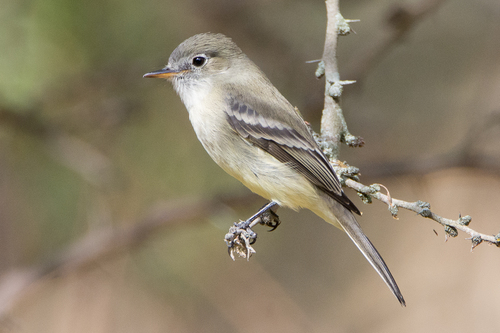
Gray Flycatcher
Empidonax wrightii
The subtle master of the sagebrush, the Gray Flycatcher is a desert specialist known for its patient hunting and iconic downward tail wag. A quintessential bird of the American West, it brings a touch of quiet elegance to any arid landscape.
Quick Identification
Size
Length: 12.5–15 cm (4.9–5.9 in); Wingspan: 22 cm (8.7 in); Weight: 10–14 g (0.35–0.49 oz)
Colors
Soft gray-brown upperparts, whitish underparts with a faint olive or yellow wash on the belly; pale white eye-ring and two distinct white wing bars.
Key Features
- Distinctive downward tail-wagging motion
- Long, narrow bill with a pale pinkish-orange base on the lower mandible
- Pale gray plumage with a prominent white eye-ring
- Preference for low perches in arid, brushy habitats
When You’ll See Them
Geographic range
Where Does the Gray Flycatcher Live?
The Gray Flycatcher is a signature species of the Great Basin and the intermountain West of North America. Its breeding range extends from southern British Columbia through eastern Washington and Oregon, spanning across Nevada, Utah, and Colorado into the high deserts of the Southwest. During the winter months, these hardy birds migrate to the arid scrublands of Arizona, New Mexico, and deep into central Mexico, following the availability of desert insects.
Basemap © OpenStreetMap contributors
Behavior
The Gray Flycatcher is a model of stoic patience in the arid West. Unlike many other flycatchers that dart frantically through the canopy, the Gray Flycatcher prefers to hunt from low-lying perches, such as the outer branches of sagebrush or pinyon pines. It is most famous among birders for its unique "downward" tail wag—a gentle, rhythmic dipping of the tail that is more subtle and deliberate than the energetic upward flicks of its close relatives.
While largely solitary and territorial during the breeding season, these birds are surprisingly tolerant of human presence if their habitat is respected. They spend much of their day "sallying"—flying out from a perch to snatch an insect mid-air or, quite commonly for this species, dropping down to the ground to seize prey from the soil. In a backyard setting, they are quiet but persistent visitors, often returning to the same favorite twig dozens of times a day.
EverydayEarth exclusive
Camera Tips
Capturing the Gray Flycatcher on a backyard camera requires an understanding of their low-profile hunting style. Unlike songbirds that flock to feeders, these flycatchers are insect-driven. Position your camera about 3 to 4 feet off the ground, aiming at a clear, horizontal "sentinel perch"—a dead branch or the top of a fence post near a brushy area. They love having a wide field of view to spot insects, so an isolated branch in a sagebrush clearing is an ideal target.
Because they frequently drop to the ground to catch beetles and grasshoppers, you can also have success with a ground-level camera trap focused on a patch of open, sandy soil. If you live in an arid area, a dripping water feature or a shallow basin is the ultimate lure; these birds are often thirsty and will visit a water source frequently during the heat of the day. Set your camera to a fast trigger speed and high-frame-rate video to catch their quick movements.
For the best lighting, aim your camera north or south to avoid the harsh, direct sun of the Western deserts, which can wash out the bird's subtle gray plumage. Early morning is the magic hour for these birds. If your camera uses AI detection, look for clips where the bird is wagging its tail downward—this is the most reliable way to confirm you've recorded a Gray Flycatcher rather than a Dusky or Hammond's Flycatcher.
Similar Species
Species that look similar or are commonly confused with Gray Flycatcher.
Dusky Flycatcher
Flicks its tail upward rather than downward and typically prefers slightly more wooded, montane shrub habitats.
Hammond's Flycatcher
Smaller with shorter bills and darker chests; they usually stay higher in the forest canopy than the Gray Flycatcher.
Say's Phoebe
Larger with a distinct cinnamon-colored belly, though it shares the same arid, open habitats.
Frequently Asked Questions
Record Gray Flycatcher at your habitat
Connect a camera to start building your own species record — AI identifies every visitor automatically.