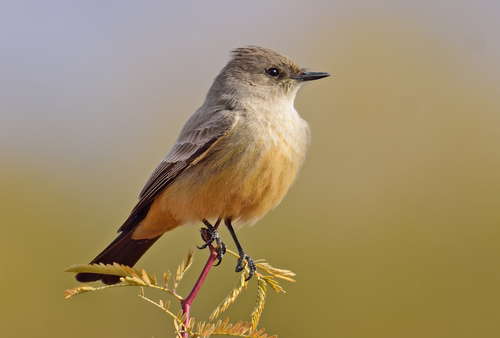
Say's Phoebe
Sayornis saya
A hardy specialist of the American West, the Say's Phoebe is a desert-loving flycatcher with a warm cinnamon belly and a penchant for nesting on porch ledges. It is the perfect subject for backyard cameras, often remaining still on open perches while it scans the horizon for insects.
Quick Identification
Size
Length: 6.7–8.3 in (17–21 cm); Wingspan: 12.6–13.8 in (32–35 cm); Weight: 0.7–1.1 oz (21–32 g)
Colors
Soft brownish-gray upperparts with a slightly darker head; distinctive cinnamon-apricot wash on the belly and undertail; black tail.
Key Features
- Warm cinnamon-orange belly and vent area
- Tail is almost black and noticeably darker than the back
- Frequent downward tail-pumping or 'dipping' motion when perched
- Slender build with a slightly peaked crown and thin black bill
When You’ll See Them
Behavior
The Say's Phoebe is a charismatic member of the tyrant flycatcher family, known for its stoic presence in the open landscapes of the West. Unlike many songbirds that hide in dense foliage, this phoebe prefers to sit out in the open on low perches like fence wires, sagebrush, or even garden stakes. From these vantage points, it performs 'sallying' maneuvers—darting out to snag an insect in mid-air with an audible snap of its beak before returning to the same spot.
One of their most endearing traits is their comfort with human proximity. They are famous 'ledge nesters,' often choosing to build their cup-shaped nests of mud and grass on porch rafters, window sills, or under the eaves of houses. This makes them one of the most accessible wild species for backyard observation. They are generally solitary outside of the breeding season but maintain a gentle, vocal presence with their soft, whistled 'phee-ee' calls.
EverydayEarth exclusive
Camera Tips
Capturing high-quality footage of a Say's Phoebe requires understanding their favorite 'lookout' spots. Because they are sit-and-wait predators, they will return to the same perch dozens of times a day. Look for a solitary fence post, a dead branch, or even a shepherd's hook in your garden. Position your camera 5 to 8 feet away from this perch at eye level with the bird. Use a fast trigger speed or a 'pre-roll' feature if your camera supports it, as their 'sallying' flights are lightning-fast and can be missed by slower sensors.
For those lucky enough to have a Say's Phoebe nesting on their home, placing a camera near the nesting ledge offers a spectacular view of their life cycle. Mount the camera roughly 3 feet away from the nest site—do this before eggs are laid to ensure you don't disturb the pair. A side-on angle is often better than looking straight up, as it allows you to see both the parents' cinnamon bellies and the gaping mouths of the chicks. Ensure the camera is set to record short, high-resolution video clips rather than just photos to capture their characteristic tail-dipping motion.
While they don't visit seed feeders, you can lure them toward your camera using water. A shallow, tiered birdbath or a dripper is highly attractive to them in dry environments. Set your camera to be active during the 'golden hours' of early morning and late afternoon; the low sun highlights the warm orange tones of their plumage beautifully. If your camera allows for manual settings, a higher shutter speed (1/1000s or faster) is recommended to freeze the action of their wings during flight.
Similar Species
Species that look similar or are commonly confused with Say's Phoebe.
Frequently Asked Questions
Record Say's Phoebe at your habitat
Connect a camera to start building your own species record — AI identifies every visitor automatically.