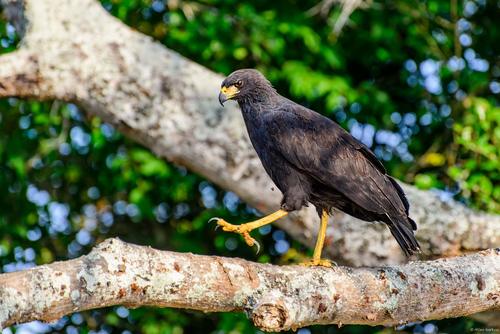
Great Black Hawk
Buteogallus urubitinga
A powerful, soot-colored sentinel of the Neotropics, the Great Black Hawk is a master of the hunt along forest rivers and coastal mangroves. With its striking yellow legs and piercing gaze, it is one of the most majestic raptors you can discover in the tropical wild.
Quick Identification
Size
Length: 56–64 cm (22–25 in); Wingspan: 110–130 cm (43–51 in); Weight: 1.1 kg (2.4 lbs)
Colors
Adults are almost entirely slate-black; bright yellow cere, lores, and legs; white base of the tail and a broad white median tail band.
Key Features
- Broad, rounded 'paddle-shaped' wings
- Bright yellow legs and facial skin
- Single broad white band across a black tail
- Heavy, hooked black beak
When You’ll See Them
Geographic range
Where Does the Great Black Hawk Live?
Native to the Neotropical realm, the Great Black Hawk is a quintessential bird of the Americas. Its core range extends from the coastal lowlands of Mexico through the entirety of Central America, reaching deep into South America as far south as northern Argentina and Uruguay. While it is a resident across most of the Amazon Basin and the Pantanal, it is most commonly encountered in tropical and subtropical regions below 1,500 meters, rarely wandering into the high Andes.
Basemap © OpenStreetMap contributors
Behavior
The Great Black Hawk is a patient and versatile predator often found near water. Unlike many soaring hawks, it frequently hunts from a perch, sitting motionless for long periods as it scans the ground or water's edge for movement. Once prey is spotted, it descends in a swift, powerful strike. They are known to be somewhat more approachable than other large raptors, though they remain vigilant and will vocalize with a piercing, whistled 'peeee-aaa' when disturbed near their nesting sites.
While generally solitary or found in pairs, these hawks exhibit intelligent foraging behaviors, such as following monkeys or even forest fires to snatch up displaced prey. They are primarily non-migratory, maintaining year-round territories where they build large stick nests high in the canopy, often near a river or swamp. Their flight is characterized by heavy, deliberate wingbeats interspersed with short glides.
EverydayEarth exclusive
Camera Tips
To capture the Great Black Hawk on camera, focus your efforts on the water's edge. These hawks are highly attracted to riparian corridors and marshy boundaries where they hunt for frogs and snakes. Position your camera approximately 3 to 5 feet off the ground, angled toward a sunlit opening near a shoreline or a known 'perch tree' that overlooks a clearing. Because they are still-hunters, they may sit for an hour in one spot; use a camera with a sensitive PIR sensor to ensure the initial landing triggers the recording.
If you are setting up in a backyard that borders a woodland or canal, high-quality video mode is preferable to stills. These birds have fascinating handling behaviors, often using their talons to manipulate prey or their beaks to tear at bark in search of grubs. Setting a 'Detection Delay' of nearly zero is vital, as their transition from perch to prey is explosive and fast. A wide-angle lens is helpful if you are placing the camera near a frequent watering hole or a shallow pool where they might bathe.
In terms of timing, the early morning hours just after sunrise provide the best lighting for their dark plumage. Black feathers can easily 'blow out' or lose detail in harsh midday sun, looking like a silhouette. Aim for North-South camera orientations to avoid direct lens flare. While they don't typically visit traditional bird feeders, a clean, permanent water feature or a pond stocked with local minnows or frogs can make your yard a regular stop on their daily patrol.
Similar Species
Species that look similar or are commonly confused with Great Black Hawk.
Common Black Hawk
Smaller with a much broader single white tail band and slightly different wing shape in flight.
Snail Kite
Features a more deeply hooked beak for eating snails and lacks the solid black appearance of the Great Black Hawk.
Zone-tailed Hawk
Mimics a Turkey Vulture in flight with tilted wings and has multiple greyish tail bands rather than the bold white of the Great Black Hawk.
Frequently Asked Questions
Record Great Black Hawk at your habitat
Connect a camera to start building your own species record — AI identifies every visitor automatically.