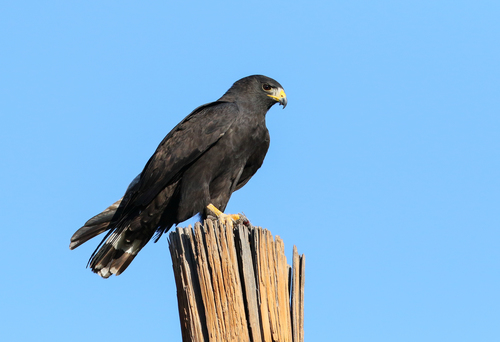
Zone-tailed Hawk
Buteo albonotatus
A master of mimicry, the Zone-tailed Hawk hides in plain sight by masquerading as a harmless vulture. Watch for this clever predator teetering through the desert thermals, waiting for the perfect moment to strike.
Quick Identification
Size
Length: 18-22 in (45-56 cm) | Wingspan: 46-55 in (117-140 cm) | Weight: 1.3-2.1 lbs (600-950 g)
Colors
Slaty-black or charcoal plumage; underside of wings show silvery-gray flight feathers with fine dark barring; tail is black with 1-3 white bands (wider on males).
Key Features
- Teetering flight style with wings in a V-shape
- Broad, rounded wings resembling a Turkey Vulture
- Black plumage with bold white tail bands
- Yellow cere (nose) and legs
When You’ll See Them
Behavior
The Zone-tailed Hawk is one of nature's most clever mimics. It frequently travels within groups of Turkey Vultures, adopting their distinctive rocking flight and 'dihedral' wing shape. Because vultures are scavengers that don't pose a threat to live prey, small animals often let their guard down, allowing the hawk to suddenly drop from the group and strike with lethal precision.
These hawks are primarily solitary hunters that patrol vast territories of arid landscapes and riparian woodlands. While they are bold in their hunting tactics, they are generally shy around humans and will aggressively defend their nesting sites in tall trees or on steep cliff faces from perceived intruders.
EverydayEarth exclusive
Camera Tips
Capturing a Zone-tailed Hawk on a backyard camera requires a strategy focused on their soaring habits rather than ground activity. Since these hawks rarely land on the ground except to strike prey, place your AI-powered camera on a high vantage point, such as a rooftop or a second-story balcony, angled slightly upward to catch them as they circle overhead. If you live near a canyon or a tall grove of trees, aim your camera toward these landmarks where they are likely to patrol.
While you shouldn't use meat as bait (as this attracts unwanted scavengers and can be illegal), maintaining a bird-friendly backyard with a large, elevated water basin can be a successful draw. Zone-tails, like many raptors, need to drink and bathe, especially in the hot, dry climates they inhabit. Position the camera about 10-15 feet away from the water source to ensure the motion trigger catches the bird as it descends.
Because the Zone-tailed Hawk is a fast-moving aerial predator, camera settings are crucial. Use a 'Burst' or 'Multi-Shot' mode to increase your chances of getting a crisp image of their white tail bands, which are the primary way to distinguish them from vultures in photos. A high shutter speed is preferred to minimize motion blur during their characteristic 'teetering' flight.
During the spring and summer months, pay attention to 'vulture' activity in your area. If your camera frequently triggers on Turkey Vultures, review the footage carefully; a Zone-tailed Hawk may be hiding in the flock. Look for the yellow legs and the banded tail in your captures, as these are the 'smoking gun' features that reveal the hawk's true identity to your AI camera.
Similar Species
Species that look similar or are commonly confused with Zone-tailed Hawk.
Turkey Vulture
The vulture has a small, unfeathered red head and lacks white bands on its tail.
Common Black Hawk
The Black Hawk has much broader wings and a single, very wide white band on the tail, whereas the Zone-tail has multiple narrower bands.
Golden Eagle
Golden Eagles are much larger with a golden-brown nape and lack the distinct white tail banding of the Zone-tail.
Frequently Asked Questions
Record Zone-tailed Hawk at your habitat
Connect a camera to start building your own species record — AI identifies every visitor automatically.