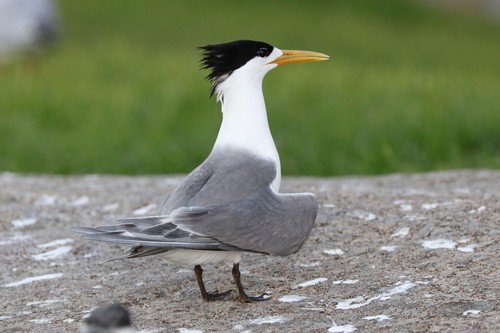
Great Crested Tern
Thalasseus bergii
A striking coastal specialist known for its shaggy black crest and surgical precision when diving for fish. The Great Crested Tern is a charismatic icon of the Indian and Pacific coastlines.
Quick Identification
Size
Length: 43–48 cm (17–19 in); Wingspan: 94–105 cm (37–41 in); Weight: 325–450 g (11–16 oz)
Colors
Pale battleship-grey upperparts, snowy white underparts and forehead, shaggy black crest, and a distinctive greenish-yellow to lemon bill.
Key Features
- Long, sharp greenish-yellow bill
- Shaggy black crest that can be raised when excited
- Distinctive white forehead even during breeding
- Deeply forked tail and long, narrow wings
When You’ll See Them
Geographic range
Where Does the Great Crested Tern Live?
The Great Crested Tern is a master of the southern oceans, with a massive native range that spans from the southern tip of South Africa and the Red Sea across the Indian Ocean to the central Pacific. They are a familiar sight along the entire coastline of Australia and many Southeast Asian archipelagos, including Indonesia and the Philippines. While they are strictly coastal residents, they are known to disperse widely across the tropical and subtropical Old World following the conclusion of their breeding seasons.
Basemap © OpenStreetMap contributors
Behavior
Great Crested Terns are highly social birds, often found in large, noisy colonies that can number in the thousands. They are masterful aerialists, spending much of their day patrolling coastal waters for schools of fish. Unlike many other tern species that might dive from great heights, these birds typically forage with shallow plunge-dives or by dipping to snatch prey from the surface of the water.
While they are gregarious with their own kind, they are generally wary of humans but have adapted well to coastal developments. You will often see them resting on piers, buoys, or sandbars between fishing trips. During the breeding season, their behavior becomes much more dramatic, involving elaborate courtship displays where pairs fly high together before gliding down in a synchronized descent.
EverydayEarth exclusive
Camera Tips
Capturing the Great Crested Tern on camera requires focusing on their favorite 'loafing' spots. These are typically flat, open areas like sandbars, jetties, or rocky outcrops where they rest between fishing bouts. Place your camera on a low tripod or a ground mount to get a 'bird's eye' perspective; a low angle makes the bird look more heroic and highlights the distinctive shaggy crest and greenish bill.
Because coastal environments are harsh, ensure your camera housing is salt-resistant or protected by a weather shield. Terns are incredibly fast, so if your AI camera allows for shutter speed priority, set it to at least 1/2000th of a second to freeze the action during takeoffs or dives. Use a high-speed SD card to handle the rapid-fire bursts required to catch the perfect wing position.
Baiting is not recommended for these birds as they prefer live, moving prey, but you can 'lure' them by choosing a location near a natural fish trap, such as an estuary mouth during an outgoing tide. Position your camera with the sun behind it (facing East in the afternoon or West in the morning) to bring out the subtle grey tones of their plumage and avoid silhouetting against the bright ocean glare.
Similar Species
Species that look similar or are commonly confused with Great Crested Tern.
Frequently Asked Questions
Record Great Crested Tern at your habitat
Connect a camera to start building your own species record — AI identifies every visitor automatically.