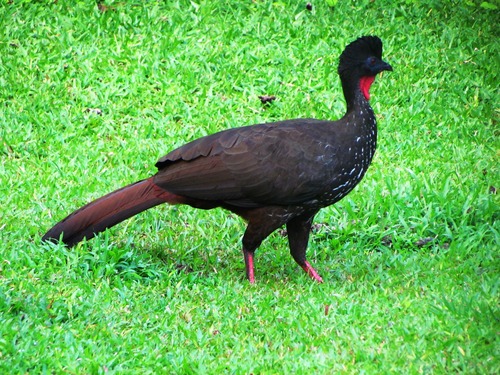
Crested Guan
Penelope purpurascens
An ancient arboreal giant of the tropical forest, the Crested Guan is a master of the canopy. With its striking red dewlap and raucous calls, this 'tree turkey' is a prized sight for any wildlife enthusiast in the Americas.
Quick Identification
Size
Length: 81–91 cm (32–36 in); Weight: 1.6–2.7 kg (3.5–6 lbs); Wingspan: 100–120 cm (39–47 in)
Colors
Dusky brown to blackish-olive plumage with prominent white streaking on the neck and chest; bare blue-gray skin around the eyes and a bright red fleshy dewlap on the throat.
Key Features
- Large, bushy crest of feathers on the crown
- Bright red pendulous dewlap on the throat
- Long, broad tail used for balancing in trees
- Distinctive white spotting/streaking on the breast
When You’ll See Them
Geographic range
Where Does the Crested Guan Live?
Native to the tropical regions of the Americas, the Crested Guan occupies a wide geographic band stretching from the coastal lowlands of central Mexico through the entirety of Central America. In South America, its core population thrives across the northern Andean countries, including Colombia, Venezuela, Ecuador, and reaching into the western Amazonian regions of Peru. These birds are primarily residents of undisturbed forest habitats, rarely migrating far from their home territories.
Basemap © OpenStreetMap contributors
Behavior
The Crested Guan is a social and highly vocal bird, often referred to as the 'tree turkey' due to its size and arboreal habits. They are typically found in pairs or small family groups of 3–10 individuals, moving through the middle and upper canopy with surprising agility. While they are primary dwellers of the treetops, they will occasionally descend to the forest floor to forage for fallen fruit or take dust baths, though they remain wary and quick to retreat to higher branches if disturbed.
During the breeding season, males perform a remarkable 'wing-drumming' display. As they fly between trees, they produce a loud, mechanical rattling sound by rapidly vibrating their wings, which serves as a territorial marker. Their vocalizations are equally impressive, consisting of loud, nasal 'honks' or barking calls that can carry over long distances through dense tropical vegetation, often being one of the first sounds heard in the rainforest at dawn.
EverydayEarth exclusive
Camera Tips
Capturing the Crested Guan on camera requires a specialized approach because they spend the vast majority of their time in the canopy. For the best results, mount your camera 10 to 15 feet high on a tree trunk overlooking a known 'fruit fall' area—spots where figs or palm nuts are dropping to the ground. If you are limited to ground-level mounting, angle the camera slightly upward to capture them as they land to forage. Use a wide-angle lens setting if available, as these birds are large and can easily fill the frame.
Luring Crested Guans is most effective with natural attractants. If you have a fruiting fig or palm tree in your area, place your camera nearby during the ripening season. While they rarely visit traditional bird feeders, they are highly attracted to water sources during the dry season. A raised birdbath or a natural depression in a log that holds rainwater can be a magnet for guans looking to drink or bathe in the heat of the afternoon.
Since these birds are most active during the low-light hours of dawn and dusk, ensure your camera has a high-quality sensor and fast trigger speed. Their dark plumage can often 'trick' auto-exposure settings into overexposing the background, so if your camera allows for exposure compensation, a slight underexposure can help preserve the detail in their white chest streaking. Avoid using a bright white flash, as it can be highly startling to this Near Threatened species; instead, opt for 'No-Glow' or 'Black' Infrared LEDs to keep your monitoring discreet.
Similar Species
Species that look similar or are commonly confused with Crested Guan.
Great Curassow
Larger with a curled feather crest and a yellow bulbous knob on the bill; lacks the red dewlap of the guan.
Black Guan
Smaller and entirely black plumage; lacks the white streaking and red dewlap, found at much higher elevations.
Spix's Guan
Found deeper in the Amazon basin; has less white streaking on the breast and a slightly different vocalization pattern.
Frequently Asked Questions
Record Crested Guan at your habitat
Connect a camera to start building your own species record — AI identifies every visitor automatically.