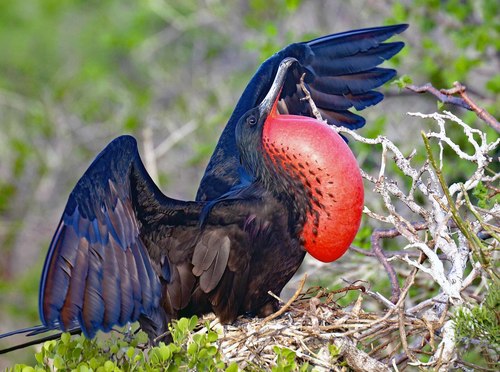
Magnificent Frigatebird
Fregata magnificens
The ultimate pirate of the tropical skies, the Magnificent Frigatebird is a master of the air. With a wingspan over seven feet and a tail like a pair of scissors, this 'Man o' War' never has to touch the water to find its next meal.
Quick Identification
Size
Length: 89–114 cm (35–45 in); Wingspan: 2.17–2.44 m (7.1–8.0 ft); Weight: 1.1–1.6 kg (2.4–3.5 lbs)
Colors
Males are entirely black with a brilliant scarlet inflatable throat pouch. Females are black with a prominent white chest and breast. Juveniles have a white head and underparts.
Key Features
- Massive deeply forked 'scissor' tail
- Long, slender wings with a distinct 'W' shape in flight
- Large, hooked gray bill
- Vibrant red inflatable gular sac (breeding males)
- White chest patch (females)
When You’ll See Them
Geographic range
Where Does the Magnificent Frigatebird Live?
The Magnificent Frigatebird is a quintessential resident of the tropical and subtropical Americas, spanning the Pacific coast from northern Mexico down to Peru and the Atlantic coast from Florida to southern Brazil. These birds are a constant presence throughout the Caribbean islands and the Gulf of Mexico, with isolated but significant breeding populations also found on the Galápagos Islands and the Cape Verde islands off the coast of Africa. While strictly coastal, they are known to follow weather patterns and can occasionally be spotted far out at sea or temporarily displaced inland after major tropical storms.
Basemap © OpenStreetMap contributors
Behavior
The Magnificent Frigatebird is often called the 'Man o' War' due to its habit of pirating food from other seabirds. Because their feathers are not waterproof, they cannot dive into the ocean or swim; instead, they are masters of the air, capable of staying aloft for weeks at a time by riding warm thermals. They are highly agile flyers, using their deeply forked tails like rudders to execute sharp turns and sudden dives.
Feeding involves a mix of skimming the water's surface for fish or engaging in kleptoparasitism—harassing boobies, gulls, and terns until they drop their catch. On land, they are colonial nesters, preferring mangroves or low-lying shrubs on offshore islands. While they generally ignore humans, they are often found hovering near fishing boats or coastal fish markets, hoping for an easy handout.
EverydayEarth exclusive
Camera Tips
To capture a Magnificent Frigatebird on camera, you must focus on coastal vantage points. If your backyard overlooks a bay, canal, or the open ocean, position your camera on a high pole or a second-story balcony. These birds rarely land on the ground, so angling the camera upward at a 30-to-45-degree angle toward the sky or toward the tops of tall mangroves is essential. They are frequently seen perched on the masts of boats or high navigational markers, so if you have a view of a marina, aim your lens there.
The best time for a clear shot is during the mid-morning and late afternoon when the sun is not directly overhead but the birds are active on thermals. Use a high-speed shutter setting (or 'Action Mode' if your AI camera has it) to account for their rapid flight and sudden turns. Because their plumage is dark, capturing them against a bright blue sky can result in underexposure; if your camera allows for exposure compensation, bumping it up slightly (+0.5 or +1.0) can help reveal the detail in their feathers.
While you can't use traditional bird feeders to attract them, they are highly sensitive to the activity of other birds and humans. Setting up a camera near a local fish-cleaning station or a pier where fishermen discard scraps is a surefire way to get close-up footage. During the winter and spring breeding months, look for males with inflated red pouches—this is the most dramatic footage you can capture. Ensure your camera housing is rated for salt-air environments, as the corrosive coastal mist can quickly damage standard electronics.
Similar Species
Species that look similar or are commonly confused with Magnificent Frigatebird.
Frequently Asked Questions
Record Magnificent Frigatebird at your habitat
Connect a camera to start building your own species record — AI identifies every visitor automatically.