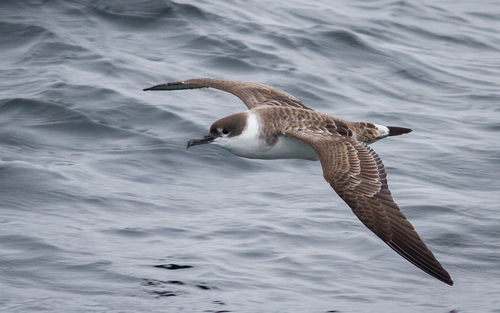
Great Shearwater
Ardenna gravis
A champion of the Atlantic, the Great Shearwater travels from the sub-Antarctic to the Arctic and back every year. Watch for its signature 'shearing' flight as it skims the waves with effortless grace.
Quick Identification
Size
Length: 43–51 cm (17–20 in); Wingspan: 105–122 cm (41–48 in); Weight: 715–950 g (1.6–2.1 lb)
Colors
Dark brown upperparts, white underparts, distinct blackish-brown cap, white collar, and a dark patch on the belly
Key Features
- Distinct dark brown cap separated by a white collar
- Large dark brown smudge on the center of the belly
- Long, slender black bill with a hooked tip
- Narrow white band at the base of the tail
When You’ll See Them
Geographic range
Where Does the Great Shearwater Live?
The Great Shearwater is a true Atlantic globetrotter, nesting exclusively on remote islands in the South Atlantic, such as Tristan da Cunha and Gough Island. Following the breeding season, they undertake an epic circular migration that brings them north through the western Atlantic to the rich feeding grounds off the coasts of the United States, Canada, and Greenland. They eventually cross over to the eastern Atlantic, passing European coastlines as they head back south to their breeding colonies.
Basemap © OpenStreetMap contributors
Behavior
The Great Shearwater is a master of the open ocean, renowned for its 'shearing' flight—a series of stiff-winged glides that bank steeply from side to side, often skimming just inches above the wave crests. These birds are highly social and are frequently seen in massive congregations, or 'rafts,' numbering in the thousands, particularly when feeding on schools of fish or resting on the water's surface.
While they spend the vast majority of their lives at sea, they are colonial breeders that return to remote, rocky islands. On the water, they are bold and competitive, often squabbling loudly with other seabirds over food. Though they rarely interact with humans on land, they are well-known to offshore fishers as they frequently follow boats to scavenge for discards, diving fearlessly into the wake.
EverydayEarth exclusive
Camera Tips
Capturing a Great Shearwater on camera requires a specialized approach since they are almost exclusively pelagic. If you live on a coastal property with high cliffs or a view of the ocean, mount your AI-powered camera on a stable, vibration-resistant pole or tripod. High-resolution sensors are critical here, as the birds will often be moving at high speeds several hundred yards offshore.
For those using cameras on boats or near piers, the best time to trigger the shutter is during 'onshore' winds, which push the birds closer to the land. Since these birds are attracted to fish oil and offal, a legal and ethical 'chum' slick can bring them within range of a deck-mounted camera. Set your camera to a very high shutter speed (1/2000s or faster) to freeze their rapid banking movements and avoid motion blur caused by the swells.
Position your camera to face slightly away from the direct sun to capture the subtle contrast between their dark cap and white throat. In terms of AI settings, focus the detection zone on the horizon line or just above the water surface. Because these birds are most active during the summer 'upwelling' months, prioritize your monitoring between June and August in the North Atlantic to catch the peak of their migration.
Similar Species
Species that look similar or are commonly confused with Great Shearwater.
Cory's Shearwater
Lacks the distinct dark cap and white collar of the Great Shearwater, and has a yellow bill instead of black.
Sooty Shearwater
Much darker overall with dark underparts, whereas the Great Shearwater is primarily white underneath.
Manx Shearwater
Significantly smaller with a pure black back and no white collar or dark belly patch.
Frequently Asked Questions
Record Great Shearwater at your habitat
Connect a camera to start building your own species record — AI identifies every visitor automatically.