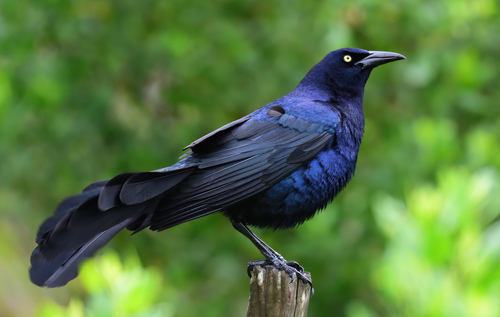
Great-tailed Grackle
Quiscalus mexicanus
The Great-tailed Grackle is a master of the urban landscape, known for its piercing yellow eyes and a voice like a malfunctioning synthesizer. This bold and intelligent socialite is one of the most charismatic birds you'll find on a backyard camera.
Quick Identification
Size
Males: 15-18 in (38-46 cm) long, wingspan 19-23 in (48-58 cm), 7-9.3 oz (200-265 g). Females: 11-13 in (28-33 cm) long, 4 oz (115 g).
Colors
Males are glossy, iridescent black with a purplish-blue sheen and bright yellow eyes. Females are charcoal-brown above and cinnamon-buff below with a pale eye-stripe.
Key Features
- Massive, keel-shaped tail often held in a 'V' shape
- Piercing bright yellow eyes (males)
- Long, heavy black bill
- Pronounced sexual dimorphism in size and color
When You’ll See Them
Geographic range
Where Does the Great-tailed Grackle Live?
Originally native to Central America and Mexico, the Great-tailed Grackle has executed one of the most successful range expansions of any bird species. They are now found throughout the southern and western United States, from California across to Louisiana and reaching as far north as Nebraska and Oregon. These birds thrive in almost any environment shaped by human activity, provided there is a reliable source of water and open ground for foraging.
Basemap © OpenStreetMap contributors
Behavior
Great-tailed Grackles are among the most social and intelligent birds found in North American suburban landscapes. They are famous for their incredibly diverse vocal repertoire, which sounds like a cacophony of rusty hinges, whistles, clicks, and electronic bleeps. Often found in large, noisy flocks, they have adapted remarkably well to human environments, frequently congregating in well-lit parking lots and city parks at dusk to form massive communal roosts.
Their social interactions are highly performative. You will often see males engaging in 'bill-up' displays, where they stretch their necks toward the sky to establish territory or dominance without physical fighting. They are bold scavengers and have been observed solving complex problems to reach food, such as opening containers or timing their visits to outdoor cafes when human activity is high.
EverydayEarth exclusive
Camera Tips
To capture the most striking footage of Great-tailed Grackles, focus your camera on low-level water features or flat ground foraging areas. These birds are highly terrestrial and spend a significant amount of time walking on the ground. Mount your camera at a low angle, roughly 12 to 18 inches high, to capture the full length of the male's impressive tail and his characteristic 'stepping' gait. Paved patios or short-grass lawns near a bird bath are prime locations.
Lighting is the biggest challenge when filming grackles. Because their plumage is iridescent black, mid-day sun can wash out the detail or create harsh highlights. Position your camera to face away from the sun, and aim for 'golden hour' captures—early morning or late afternoon—which will bring out the deep purples and blues in the male's feathers. If your camera allows for exposure adjustment, slightly underexposing the image can help preserve the detail in their dark feathers.
Because they are bold and curious, grackles are easily attracted to bait. A mix of cracked corn and sunflower seeds scattered on the ground will keep them in the frame longer than a hanging feeder would. If you want to see their unique social behaviors, use a wide-angle lens setting to capture multiple birds at once, as they rarely travel alone. They are particularly active during the spring breeding season when males are constantly displaying their tails and calling.
Similar Species
Species that look similar or are commonly confused with Great-tailed Grackle.
Boat-tailed Grackle
Nearly identical but typically has dark eyes and a more rounded crown; restricted to coastal marshes.
Common Grackle
Much smaller with a shorter tail and a more bronzed or golden-green iridescence rather than purple.
Brewer's Blackbird
Significantly smaller with a much shorter, square tail and lacks the 'keeled' tail shape of the grackle.
Frequently Asked Questions
Record Great-tailed Grackle at your habitat
Connect a camera to start building your own species record — AI identifies every visitor automatically.