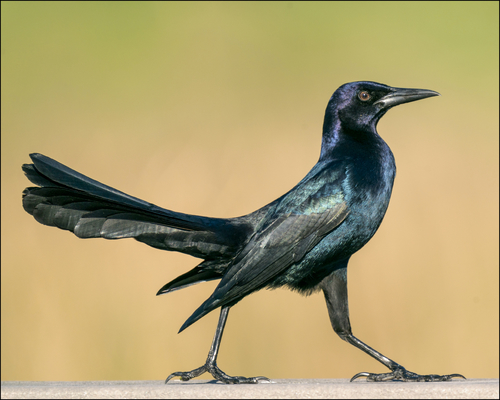
Boat-tailed Grackle
Quiscalus major
A bold and shimmering icon of the American coastline, the Boat-tailed Grackle is a master of the salt marsh. With its oversized tail and metallic song, this intelligent bird brings a touch of wild drama to any backyard camera.
Quick Identification
Size
Length: 26–43 cm (10–17 in); Wingspan: 39–50 cm (15–20 in); Weight: 93–239 g (3.3–8.4 oz)
Colors
Males are iridescent black with blue or purple sheen; females are significantly smaller and tawny-brown with paler underparts; eyes range from yellow to brown depending on the region.
Key Features
- Extraordinarily long V-shaped 'keeled' tail in males
- Dramatic sexual dimorphism in size and color
- Large, heavy black bill
- Pointed wings and long legs
When You’ll See Them
Geographic range
Where Does the Boat-tailed Grackle Live?
Native to the North American continent, the Boat-tailed Grackle is a specialized resident of the Atlantic and Gulf Coasts of the United States. Its range forms a narrow ribbon along the shoreline from southern New Jersey down through the Florida peninsula and westward along the Gulf Coast into eastern Texas. Unlike many other grackle species, they are rarely found more than a few miles from saltwater or brackish environments.
Basemap © OpenStreetMap contributors
Behavior
Boat-tailed Grackles are charismatic and highly social birds, often seen in noisy groups along the coast. Males are famous for their elaborate courtship displays, where they puff out their feathers, point their bills skyward, and vibrate their wings while emitting a complex series of harsh, metallic whistles and clucks. They are bold and intelligent, frequently adapting to human presence by scavenging in outdoor dining areas or parking lots.
These birds are remarkably gregarious, nesting in colonies often located in reeds or trees overhanging water to deter land-based predators. Within these colonies, a dominant male typically defends a harem of several females. Their interactions are loud and constant, making them one of the most prominent auditory fixtures of the coastal Southeast.
EverydayEarth exclusive
Camera Tips
To capture the best footage of Boat-tailed Grackles, position your camera low to the ground or near the edge of a water feature. Because they are ground-foragers that frequent marshy edges, a camera angled slightly upward from a height of 1 to 2 feet will capture their impressive tail length and confident 'swagger.' If you are near the coast, placing a camera facing a shallow birdbath can result in spectacular bathing videos where their iridescence is fully on display.
Lighting is the biggest challenge when filming these birds. Their feathers are highly reflective; in harsh midday sun, they can look like a featureless black silhouette, or conversely, create 'hot spots' of white light. Aim your camera toward the west for morning captures or the east for late afternoon. This 'golden hour' light brings out the deep purples and blues in the male’s plumage that are otherwise invisible to the naked eye.
For trigger settings, use a high-sensitivity PIR (Passive Infrared) sensor setting. Grackles move with quick, jerky motions and are very fast flyers. A trigger speed of 0.3 seconds or faster is ideal to ensure you don't just catch a disappearing tail. If your camera supports it, use 'Video Mode' with a 20-second clip length to record their unique vocalizations and wing-fluttering displays, which are far more interesting than a static image.
Similar Species
Species that look similar or are commonly confused with Boat-tailed Grackle.
Great-tailed Grackle
Very similar but has a flatter head profile and is found further inland and westward; eye color is always yellow in Great-tailed adults.
Common Grackle
Much smaller with a shorter tail; found across the entire eastern US, including far inland areas where Boat-tails are absent.
Fish Crow
While also black and coastal, it is larger, lacks the iridescent shimmer, and has a much thicker, crow-like beak and square tail.
Frequently Asked Questions
Record Boat-tailed Grackle at your habitat
Connect a camera to start building your own species record — AI identifies every visitor automatically.