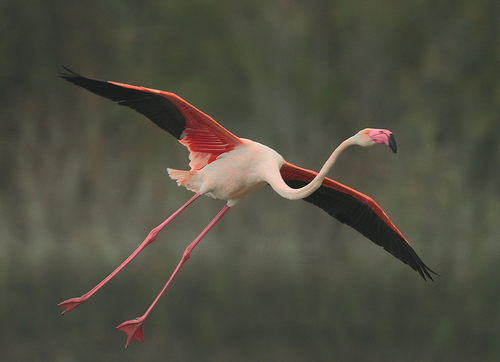
Greater Flamingo
Phoenicopterus roseus
The world's largest and most iconic flamingo, the Greater Flamingo turns shallow wetlands into a sea of pink. Known for their synchronized 'dances' and remarkable filter-feeding bills, they are the undisputed royalty of the salt pans.
Quick Identification
Size
110–150 cm (43–59 in) tall, wingspan 140–170 cm (55–67 in), weight 2–4 kg (4.4–8.8 lbs)
Colors
Pale pinkish-white body; primary and secondary wing feathers are black; wing coverts are bright coral red; legs and bill are pink with a distinct black tip.
Key Features
- S-curved neck and exceptionally long pink legs
- Distinctive downward-hooked bill with a black tip
- Largest flamingo species with pale, almost white plumage compared to relatives
- Crimson and black wing accents visible primarily during flight
When You’ll See Them
Geographic range
Where Does the Greater Flamingo Live?
The Greater Flamingo is the most widespread member of its family, native to the diverse landscapes of Africa, Southern Europe, and Southern and Southwestern Asia. From the iconic Camargue marshes of France and the coastal lagoons of Spain to the Great Rift Valley in Kenya and the salt pans of India, these birds follow the water. While many populations are resident, Northern populations in Kazakhstan and the Middle East are known to migrate or move nomadically to escape freezing winters or drought.
Basemap © OpenStreetMap contributors
Behavior
Greater Flamingos are intensely social birds that thrive in colonies numbering from a few dozen to several thousand individuals. They are famous for their synchronized group displays, such as 'head flagging' and 'wing saluting,' which they use to coordinate breeding within the colony. Despite their delicate appearance, they are hardy travelers, often flying hundreds of miles at night to find better feeding grounds as water levels change.
Their feeding behavior is a marvel of evolution. They stand in shallow water and use their feet to stir up the mud, then submerge their heads upside down to filter out tiny organisms. While they are generally wary of humans and will take flight if approached, they can become habituated to observers in protected salt pans and coastal lagoons, provided no sudden movements are made.
EverydayEarth exclusive
Camera Tips
To capture the Greater Flamingo on a trail camera, focus on the water’s edge in shallow lagoons or salt pans. Because these birds are tall, mount your camera roughly 3 feet (1 meter) off the ground on a stable stake. If you place it too low, you may only get shots of their legs; placing it slightly higher and angling it downward ensures you capture their unique feeding 'head-down' posture and their elegant necks.
Lighting is the most critical factor for this species. Their pale feathers can easily overexpose in the harsh midday sun of an open wetland. Position your camera facing North or South to avoid direct lens flare, and if your camera allows for exposure adjustment, set it to -0.5 to preserve the detail in their white and pink plumage. The 'golden hour'—just after sunrise and before sunset—will yield the most spectacular colors, turning their pale feathers into a glowing coral pink.
Saltwater environments are notoriously tough on gear. If you are deploying a camera near a saline lake, use a high-quality weather seal and consider applying a light coat of anti-corrosive spray to any external metal latches. Since Greater Flamingos are easily spooked by movement, choose a camera with a silent shutter and a high-quality infrared flash for night shots, as they are surprisingly active foragers after dark. Using a solar panel is a great strategy here, as their preferred habitats are typically wide open with maximum sun exposure.
Similar Species
Species that look similar or are commonly confused with Greater Flamingo.
Frequently Asked Questions
Record Greater Flamingo at your habitat
Connect a camera to start building your own species record — AI identifies every visitor automatically.