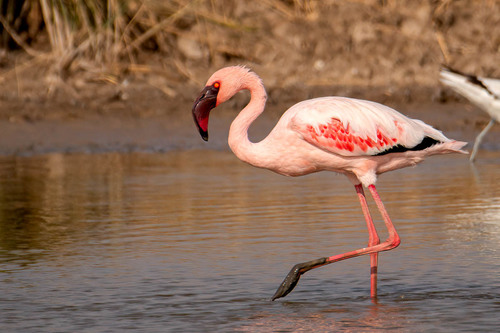
Lesser Flamingo
Phoeniconaias minor
The Lesser Flamingo is the vibrant soul of the Rift Valley, forming the largest and most breathtaking avian spectacles on Earth. Despite being the smallest of its kind, its deep pink plumage and massive social colonies make it a true icon of the tropical wetlands.
Quick Identification
Size
Length: 80-90 cm (31-35 in); Wingspan: 95-105 cm (37-41 in); Weight: 1.2-2.7 kg (2.6-6.0 lbs)
Colors
Vivid pink to off-white plumage with deep crimson flight feathers; dark, deep-maroon bill; red or orange eyes; pink legs.
Key Features
- Smallest of all flamingo species
- Deeply hooked, dark maroon-red bill that appears almost black
- Bright red eyes surrounded by a small patch of dark skin
- Stately pink legs with three webbed toes
When You’ll See Them
Geographic range
Where Does the Lesser Flamingo Live?
The Lesser Flamingo is primarily native to sub-Saharan Africa, with its most iconic and dense populations concentrated within the Great Rift Valley of Kenya, Tanzania, and Ethiopia. Outside of Africa, a significant and vital breeding population thrives in western India and parts of Pakistan, specifically in the Rann of Kutch. While they are occasionally reported as vagrants in the Middle East or southern Europe, they are most reliably found in the caustic, high-pH lakes of the tropics.
Basemap © OpenStreetMap contributors
Behavior
Lesser Flamingos are intensely social birds, often found in massive "carpets" of pink numbering in the hundreds of thousands or even millions. These colonies are tight-knit, performing synchronized group displays where thousands of birds march, head-flag, or wing-salute in unison. These ritualized movements are not just for show; they help synchronize breeding within the colony, ensuring that chicks hatch at the same time for maximum protection.
These birds are largely nomadic, moving across vast distances under the cover of night to find saline lakes with the perfect concentration of algae. While they are active during the day, they often feed most intensely at night or in the early morning when the water surface is calm, making it easier to filter-feed. Though generally wary of humans, they can become accustomed to observers if approached slowly and quietly in their wetland habitats.
EverydayEarth exclusive
Camera Tips
To capture the stunning pink of the Lesser Flamingo, place your camera along the muddy shorelines of alkaline water bodies where the birds congregate to feed. Because these birds are sensitive to movement, a low-profile ground stake or a tripod camouflaged with local vegetation is essential. Position the lens about 12-18 inches (30-45 cm) off the ground to capture the "eye-level" perspective of a wading bird, which creates a more intimate and professional-looking shot.
Since Lesser Flamingos are most active at dawn, dusk, and even overnight, ensure your camera has high-quality infrared capabilities or a fast trigger speed to handle low-light conditions. If your camera allows for video, set it to 30-second clips to capture their unique 'scything' feeding motion, where they move their heads side-to-side through the water. Avoid using white-light flashes, as this can startle the entire flock and cause a mass-departure.
Salt and alkaline dust are extremely corrosive to electronic equipment. If you are placing a camera near a soda lake, use a protective weather housing and consider wiping the exterior and lens with a damp, fresh-water cloth every few days. A desiccant pack inside the housing is also recommended to manage the high humidity often found near large tropical water bodies.
Timing is everything with this nomadic species. They follow the algae blooms, which are triggered by specific rainfall patterns. Check local birding reports before deploying your gear; if the water level is too high or too low, the flamingos may move hundreds of miles overnight. Look for 'feathers on the shore' as a sign that a flock has recently been active in the area.
Similar Species
Species that look similar or are commonly confused with Lesser Flamingo.
Frequently Asked Questions
Record Lesser Flamingo at your habitat
Connect a camera to start building your own species record — AI identifies every visitor automatically.