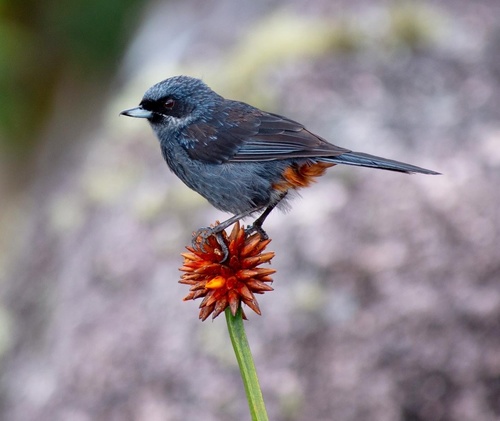
Greater Flowerpiercer
Diglossa major
Meet the 'nectar thief' of the sky islands. The Greater Flowerpiercer is a specialized high-altitude songbird that has evolved a unique way to cheat the system and steal its meals.
Quick Identification
Size
Length of 17–18 cm (6.7–7.1 in); weight between 17–28 g (0.6–1.0 oz)
Colors
Glossy bluish-black plumage with a deep violet sheen; black bill, legs, and feet; dark brown or black eyes
Key Features
- Distinctive up-turned bill with a hooked upper mandible
- Large size for the Diglossa genus
- Uniformly dark, glossy plumage without a mask
- Sturdy, notched tail
When You’ll See Them
Geographic range
Where Does the Greater Flowerpiercer Live?
The Greater Flowerpiercer is a specialist of the ancient South American highlands known as the Pantepui region. It is natively found across the flat-topped mountains, or tepuis, of southeastern Venezuela, western Guyana, and the northern fringes of Brazil. Because these tepuis act like biological islands, the species is restricted to these high-altitude summits and the immediate slopes surrounding them, making it a prized find for birdwatchers in the region.
Basemap © OpenStreetMap contributors
Behavior
The Greater Flowerpiercer is famously known as a 'nectar thief.' Unlike hummingbirds that assist in pollination, this bird uses its specialized hooked bill to pierce the base of tubular flowers. It then extracts nectar through the hole, bypassing the flower's reproductive organs entirely. This unique evolutionary adaptation allows it to feed on a wide variety of flowers that would otherwise be too long or narrow for its beak.
These birds are typically solitary and can be quite territorial around prime feeding sites. They are most often seen flitting actively through low shrubbery or mid-story canopy in the mist-shrouded highlands. While they aren't particularly shy, their dark plumage can make them difficult to spot against the shadows of the dense montane foliage unless they catch the light.
EverydayEarth exclusive
Camera Tips
To capture the Greater Flowerpiercer on camera, you need to identify their 'traplining' routes. These birds often visit the same sequence of flowering shrubs daily. Look for native plants with tubular red or yellow flowers, such as those in the Ericaceae family. If you see tiny punctures at the base of the flower corollas, you've found a primary feeding site. Mount your AI-powered camera roughly 1 to 1.5 meters off the ground, angled slightly downward toward the flower clusters.
Lighting is a significant challenge in the tepui cloud forests. Use a camera with a high-quality sensor capable of handling low-light conditions, as these birds are most active during the misty early morning hours. Setting your camera to a fast trigger speed is essential; flowerpiercers spend only a few seconds at each blossom before darting to the next. A burst mode of 3-5 photos per trigger will help ensure you catch the specific moment the bill is inserted into the flower base.
Avoid using artificial bird feeders if you are in a remote area, as the goal is to observe natural 'theft' behavior. Instead, focus on natural lures. If your camera is near a garden or lodge in their range, planting native high-altitude flora will act as a permanent attractant. Ensure the camera lens is kept clean of moisture and fog, which are common in their humid, high-altitude habitat, perhaps by using a small weather shield or rain hood.
Similar Species
Species that look similar or are commonly confused with Greater Flowerpiercer.
Frequently Asked Questions
Record Greater Flowerpiercer at your habitat
Connect a camera to start building your own species record — AI identifies every visitor automatically.