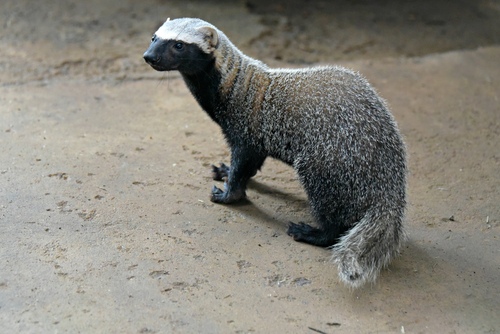
Greater Grison
Galictis vittata
With its striking racing stripe and sleek, energetic build, the Greater Grison is the 'speedster' of the Neotropical forest floor.
Quick Identification
Size
Head-body length of 45-60 cm (18-24 in) with a 15-20 cm (6-8 in) tail; weighs between 1.5-3.8 kg (3.3-8.4 lbs).
Colors
Striking contrast with a black face, chest, and belly; grizzled smoke-gray or yellowish-gray back; a distinct white or cream-colored stripe runs across the forehead and down the sides of the neck.
Key Features
- Broad white stripe separating black face from gray back
- Elongated, weasel-like body with short legs
- Small, rounded ears set low on the head
- Plantigrade feet with partial webbing
When You’ll See Them
Geographic range
Where Does the Greater Grison Live?
The Greater Grison is a quintessential Neotropical carnivore, claiming a massive territory that begins in the tropical lowlands of southern Mexico and stretches through the heart of Central America. Its expansive range continues deep into South America, covering the Amazon basin and reaching as far south as northern Argentina, Paraguay, and southern Brazil. This species is a true lowland specialist, thriving in the warm, humid environments that define the American tropics.
Basemap © OpenStreetMap contributors
Behavior
The Greater Grison is a remarkably agile and versatile member of the weasel family. While primarily terrestrial, they are excellent swimmers and capable climbers, often found near water sources where they hunt and travel. They are known for their high-energy, bounding gait and a curious but cautious nature. Unlike many other mustelids, they are frequently seen in pairs or small family groups, suggesting a more social structure than the strictly solitary life of many of their cousins.
These predators are opportunistic and high-speed hunters. They use their slender bodies to investigate burrows, hollow logs, and rock crevices for prey. When threatened, they can emit a pungent musk from their anal glands, similar to a skunk, though they rely more on their speed and ability to disappear into dense undergrowth to avoid conflict. In areas where they live near human settlements, they are generally elusive but may occasionally be drawn to poultry or small livestock.
EverydayEarth exclusive
Camera Tips
To capture the Greater Grison on camera, placement is everything. These animals are low-slung and tend to hug 'high-traffic' wildlife corridors such as the banks of streams, fallen logs that act as natural bridges, or the edges where dense forest meets open clearings. Position your camera low to the ground—about 6 to 12 inches high—to capture their unique facial markings and bounding movement. An upward angle can help if the terrain is uneven, but a straight-on shot at their eye level produces the most intimate portraits.
Because Grisons move with the characteristic 'mustelid speed,' often pausing only for a split second, you must prioritize trigger speed. Set your camera to its fastest possible trigger and use a 'Burst Mode' or high-frame-rate video. A 10-20 second video clip is often far more valuable than a still photo, as it captures their undulating gait and investigative behavior. If your camera supports it, use a high-speed SD card to minimize the 'recovery time' between shots.
Scent can be a powerful lure for this curious species. While they are wary of human scent, a small amount of fish-based lure or even a musk-based scent intended for martens or minks can encourage them to linger in front of the lens. Place the lure behind a natural obstacle like a rock or log so the animal has to move into the frame to investigate. Since they are active both during the day and at night, ensure your camera has a strong 'No-Glow' infrared flash to avoid spooking them during nocturnal hunts.
Similar Species
Species that look similar or are commonly confused with Greater Grison.
Lesser Grison
Smaller in size and typically found at higher elevations or more open, temperate habitats in the southern part of South America.
Tayra
Much larger with a uniform dark brown or black body and a yellowish-white throat patch, lacking the Grison's white facial stripe.
Long-tailed Weasel
Much smaller and thinner, with a brown back and yellowish belly, lacking the distinct gray-on-black color scheme.
Frequently Asked Questions
Record Greater Grison at your habitat
Connect a camera to start building your own species record — AI identifies every visitor automatically.