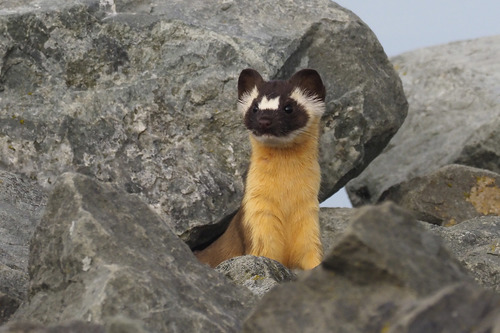
Long-tailed Weasel
Neogale frenata
Meet the Long-tailed Weasel, a bold and agile hunter that packs a massive personality into a slender, tube-shaped frame. Whether sporting its cinnamon summer coat or winter whites, this elusive visitor is a master of the backyard 'hide-and-seek.'
Quick Identification
Size
28–52 cm (11–20.5 in) total length; weight 80–450 g (3–16 oz)
Colors
Cinnamon-brown back with creamy yellow-white belly in summer; may turn pure white in winter (northern populations). Always features a black tail tip.
Key Features
- Slender, tube-like body with short legs
- Tail is at least half the length of the body
- Distinct black tip on the tail year-round
- Small, flattened head with prominent whiskers
When You’ll See Them
Geographic range
Where Does the Long-tailed Weasel Live?
Native to the Western Hemisphere, the Long-tailed Weasel claims one of the most expansive geographic ranges of any North American carnivore. Their territory stretches from the southern fringes of Canada across nearly the entire contiguous United States, skipping only the most arid desert regions. Beyond the U.S. border, they thrive throughout Mexico and Central America, extending their reach into the northern and Andean regions of South America, making them a truly pan-American species.
Basemap © OpenStreetMap contributors
Behavior
The Long-tailed Weasel is a relentless and high-energy predator, often described as a 'pocket-sized whirlwind.' Because of their exceptionally high metabolism, they must eat roughly 40% of their body weight every single day. This drives them to be active at all hours, though they lean toward crepuscular and nocturnal hunting. They are solitary animals, fiercely defending territories that can range from 30 to 40 acres depending on food availability.
When hunting, they use a zig-zag pattern, investigating every burrow, rock crevice, and hollow log they encounter. They are surprisingly bold and have been known to take down prey significantly larger than themselves, such as full-grown rabbits. While they are primarily ground-dwellers, they are also skilled swimmers and agile climbers, occasionally raiding bird nests in trees.
EverydayEarth exclusive
Camera Tips
Capturing a Long-tailed Weasel on camera requires speed and strategy. Because they are low-slung and incredibly fast, you should mount your camera just 6–12 inches off the ground. Aim the lens at 'pinch points' where their movement is restricted, such as a gap in a stone wall, a narrow space between logs, or along the edge of a foundation. If your camera has a 'fast trigger' or 'burst mode,' enable it; these animals rarely stay still for more than a second.
Video mode is highly recommended over still photos. A 10–15 second clip is often the only way to distinguish their fluid, undulating gait from a squirrel or rat. Set your camera’s sensitivity to high, as their small body mass may not always trigger passive infrared (PIR) sensors at long distances. To keep them in the frame longer, consider placing a scent lure—like a commercial marten or fisher lure—on a nearby branch or rock to encourage them to stop and sniff.
During the winter months in northern climates, keep an eye out for their white 'ermine' phase. If your camera is positioned against snow, you may need to adjust your exposure settings to avoid 'white-out' clips. Their black tail tip is often the first thing that catches the eye against a snowy background. Check areas near woodpiles or bird feeders, where the rodents they hunt are likely to congregate.
Similar Species
Species that look similar or are commonly confused with Long-tailed Weasel.
Frequently Asked Questions
Record Long-tailed Weasel at your habitat
Connect a camera to start building your own species record — AI identifies every visitor automatically.