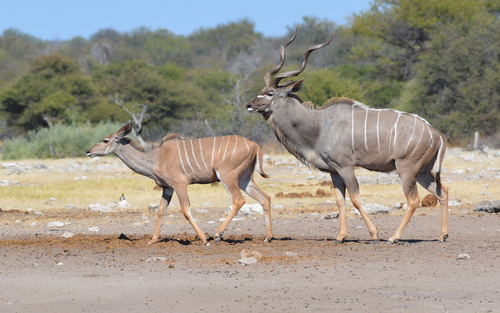
Greater Kudu
Tragelaphus strepsiceros
Meet the 'Grey Ghost' of the savanna. With its towering spiral horns and masterful camouflage, the Greater Kudu is one of Africa's most majestic and elusive woodland monarchs.
Quick Identification
Size
Length: 1.8-2.5m (6-8ft); Weight: 120-315kg (265-700lbs); Shoulder height: 1-1.5m (3.3-5ft)
Colors
Fawn-grey to reddish-brown coat with 4-12 white vertical stripes; males feature spectacular dark manes and spiral horns
Key Features
- Massive spiral horns on males with up to 2.5 twists
- Distinct white chevron stripe between the eyes
- Large, rounded ears with pinkish interiors
- Vertical white stripes on the torso for camouflage
When You’ll See Them
Sightings on EverydayEarth
Jul 30, 2026
Four male Greater Kudu bulls stand alert in an open grassy area. They are looking around cautiously, their large ears twitching to catch sounds, before one begins to lower its head toward the ground.
Jul 30, 2026
A female Greater Kudu is seen walking along the grassy bank of a watering hole. She moves cautiously through the tall dry grass and brush, her large ears swiveling to listen for potential threats before she turns and walks away from the water.
Jul 27, 2026
Two male Greater Kudus are drinking and standing at the edge of the waterhole, displaying their impressive spiral horns. In the background, a large herd of Plains Zebras is grazing across the dry grassland. Several birds, including an Egyptian Goose, are perched or walking near the water's edge.
Jul 26, 2026
A Greater Kudu walks across the background through the dry woodland vegetation. On the far bank of the watering hole, a pair of Egyptian Geese are seen resting quietly near the water's edge.
Jul 26, 2026
A male Greater Kudu walks across the foreground from left to right. In the middle ground, two Common Wildebeest stand near the edge of the waterhole. A Plains Zebra is visible in the distance on the hillside. The scene is accompanied by the loud calls of birds near the water.
Jul 25, 2026
A female Greater Kudu stands alert in the foreground, its large ears twitching as it watches the surroundings. In the distance, a group of Plains Zebras is gathered around the drying watering hole. Several Olive Baboons can also be seen moving through the scrubland near the water's edge.
Geographic range
Where Does the Greater Kudu Live?
The Greater Kudu is native to the African continent, primarily occupying the vast savanna woodlands of Eastern and Southern Africa. Their range extends from the scrublands of Ethiopia, Eritrea, and South Sudan in the north, stretching down through East Africa into the core populations of Zimbabwe, Namibia, Botswana, and South Africa. They are remarkably adaptable to different altitudes, provided there is enough thicket for cover and a reliable source of browse to sustain them through the dry season.
Basemap © OpenStreetMap contributors
Recorded on EverydayEarth
Behavior
The Greater Kudu is often referred to as the 'Grey Ghost' of the African bush due to its uncanny ability to remain motionless and undetected in thick cover. They are primarily crepuscular, meaning they are most active during the cool transitions of dawn and dusk. When threatened, a Kudu will usually stand dead still, relying on its striped coat to blend into the dappled light of the woodland; if pressed, they flee with a distinctive rocking-horse gait, often letting out a loud, barking alarm call that can be heard for miles.
Socially, these antelopes are not highly territorial. Females and their calves live in small, flexible herds, while adult males are often solitary or join loose bachelor groups. During the rut, bulls will compete for access to females using their massive horns in wrestling matches, though these rarely result in serious injury. They are remarkably agile for their size, capable of leaping over fences or obstacles more than 2 meters (6.5 feet) high from a near-standing start.
EverydayEarth exclusive
Camera Tips
Capturing the Greater Kudu on a trail camera requires a bit more height and strategy than smaller backyard wildlife. Because adult bulls can stand 1.5 meters at the shoulder, you should mount your AI-powered camera at chest height—approximately 1.3 to 1.5 meters from the ground. If you mount it too low, you may only capture shots of their legs or underbelly. Tilt the camera slightly upward if you are positioning it on a slope to ensure those massive 6-foot spiral horns make it into the frame.
Since Kudus are extremely skittish, placement is most effective near 'pinch points' where they are forced to move through thick brush, or near natural attractions like mineral licks and water holes. During the dry season, they visit water sources frequently, making these the best spots for high-quality daytime and nighttime captures. Use a high-sensitivity PIR (Passive Infrared) setting, as Kudus often move very slowly and cautiously; a low-sensitivity setting might fail to trigger as they gingerly pick their way through the foliage.
Avoid using cameras with a bright white-light flash, as the 'Grey Ghost' is notoriously light-sensitive. A high-quality 'no-glow' or black infrared flash is essential to avoid spooking the herd, which might otherwise abandon the trail for weeks. If your camera allows for video mode, set it to 15-20 second clips. This allows you to observe their fascinating social behaviors, such as the way they tilt their heads back to lay their horns against their shoulders when running through thick thorns to prevent getting snagged.
Similar Species
Species that look similar or are commonly confused with Greater Kudu.
Frequently Asked Questions
Record Greater Kudu at your habitat
Connect a camera to start building your own species record — AI identifies every visitor automatically.