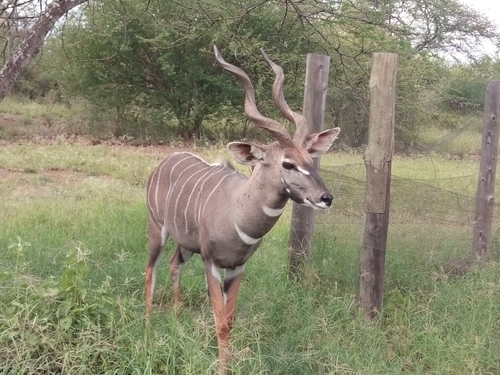
Lesser Kudu
Tragelaphus imberbis
A master of camouflage in the African scrub, the Lesser Kudu is famous for its stunning spiraled horns and intricate white stripes. Often called the 'ghost of the thicket,' this elusive antelope is a prime prize for any trail camera enthusiast.
Quick Identification
Size
Shoulder height of 90-110 cm (35-43 in); body length of 110-140 cm (43-55 in); weighs 60-105 kg (132-231 lbs).
Colors
Deep grey-brown (males) or rufous-brown (females) with 11-14 distinct white vertical stripes; two white patches on the throat and neck; males have spiraled horns with yellow tips.
Key Features
- 11-14 distinct white vertical stripes on the torso
- Two white patches on the throat and chest
- Large, rounded ears for detecting predators
- Males have tightly spiraled horns up to 35 inches long
- No throat mane (unlike the Greater Kudu)
When You’ll See Them
Sightings on EverydayEarth
Jul 31, 2026
A Lesser Kudu is seen browsing in the shadows behind a large acacia tree. It moves slowly, its head lowered as it feeds on vegetation among the dry grass and lower branches.
Jul 10, 2026
Two Lesser Kudu are foraging in a dense thicket. One individual on the left side of the frame is partially obscured by dry branches but clearly displays characteristic white vertical stripes on its flanks. A second, darker individual is seen browsing deeper in the shadows on the right.
Jun 10, 2026
Two Lesser Kudus are foraging in a thicket. One animal in the center-left is partially obscured by a bush before raising its head to look directly toward the camera, revealing its distinct facial markings and large ears. To the right, the hindquarters of a second individual are visible as it grazes.
May 29, 2026
A group of Lesser Kudu are gathered in a lush, green woodland clearing. A female grazes in the center with a small bird perched on its back, while several others rest nearby, partially hidden in the tall grass. The kudus appear relaxed but alert, occasionally lifting their heads and twitching their large ears to scan the environment.
Apr 20, 2026
A group of Lesser Kudu is resting calmly in the tall grass. Several females and at least one male with prominent spiral horns are visible. They remain mostly stationary, occasionally twitching their large ears or turning their heads to monitor the surroundings while the wind sways the vegetation around them.
Apr 13, 2026
A small group of Lesser Kudus, including two males with impressive spiral horns, grazes on a green hillside. Several Red-billed Oxpeckers are seen hitching a ride on the antelopes' backs, moving along their fur to forage for parasites.
Geographic range
Where Does the Lesser Kudu Live?
Native to the Horn of Africa and the East African Rift Valley, the Lesser Kudu is a specialist of the semi-arid bushlands. Its core range spans through Ethiopia, Kenya, Somalia, and Tanzania, with smaller populations found in parts of Uganda and South Sudan. They are localized to these drought-resistant thickets and have not been introduced outside their native African range.
Basemap © OpenStreetMap contributors
Behavior
The Lesser Kudu is a remarkably shy and elusive antelope, often referred to as a 'ghost of the thicket.' Unlike many other African ungulates, they prefer dense, semi-arid scrub where they can remain hidden from predators like leopards and lions. They are primarily crepuscular, becoming most active in the cool hours of dawn and dusk, though they may forage well into the night in areas with human activity.
Socially, they are less gregarious than other bovids. Females typically live in small groups of two or three, often consisting of a mother and her offspring, while adult males are largely solitary or form loose bachelor groups. When startled, they give a sharp barking alarm call and bound away with high leaps, their bushy tails arched to reveal a white underside—a signal to others that danger is near.
EverydayEarth exclusive
Camera Tips
To capture the elusive 'ghost of the thicket,' placement is everything. Lesser Kudu are incredibly wary of open spaces, so position your camera along the edges of dense scrub or near narrow game trails that lead into acacia thickets. Mount the camera at about 3 to 4 feet high—roughly chest level for an adult—and angle it slightly downward to ensure you catch the distinct white leg markings and the throat patches that are key for identification.
Because they are most active during the low-light hours of dawn and dusk, choose a camera with a high-quality infrared sensor and a fast trigger speed. Lesser Kudu move with a delicate, ghost-like gait but can bolt instantly if they sense something unusual; a trigger speed of 0.3 seconds or faster is ideal. Avoid using white-flash cameras, as the bright light will likely spook them and prevent them from returning to that spot for weeks.
In terms of lures, avoid standard mineral blocks if you are in a region where they might attract unwanted large predators. Instead, look for natural 'draws' like a fruiting acacia tree or a small, secluded water hole during the dry season. Even though they don't drink often, they will visit water sources to browse the lush vegetation nearby. Check your SD cards monthly to minimize human scent in their territory, as these antelopes have a highly developed sense of smell.
Similar Species
Species that look similar or are commonly confused with Lesser Kudu.
Frequently Asked Questions
Record Lesser Kudu at your habitat
Connect a camera to start building your own species record — AI identifies every visitor automatically.