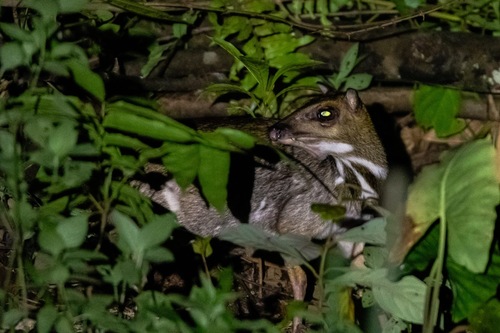
Greater Oriental Chevrotain
Tragulus napu
The Greater Oriental Chevrotain is a 'living fossil' that looks like a miniature deer but carries the tusks of a predator. Elusive and nocturnal, this tiny ungulate is a master of disappearing into the shadows of the Southeast Asian jungle.
Quick Identification
Size
70-75 cm (28-30 in) in length; Weight 5-8 kg (11-18 lbs)
Colors
Orange-brown upperparts with a grizzled appearance; white underparts; distinct pattern of five white diagonal stripes on the throat
Key Features
- Arched back with slender, pencil-thin legs
- Five white stripes on the throat
- Males have protruding, saber-like canine tusks instead of antlers
- Large, dark eyes positioned on the sides of a triangular head
When You’ll See Them
Geographic range
Where Does the Greater Oriental Chevrotain Live?
Native to the humid tropical regions of Southeast Asia, the Greater Oriental Chevrotain is a specialist of the lowland rainforest. Its core range spans the vast archipelagos of Indonesia and Malaysia, including the major islands of Sumatra and Borneo. It is also commonly found in the southern reaches of Thailand and Myanmar, as well as several smaller islands throughout the Sunda Shelf, where dense canopy cover provides the safety it needs to thrive.
Basemap © OpenStreetMap contributors
Behavior
The Greater Oriental Chevrotain is a shy, solitary creature that navigates the forest floor with a unique, hunched gait. Despite being commonly called a 'mouse-deer,' it belongs to an ancient family of ungulates that has remained largely unchanged for millions of years. They are strictly nocturnal, emerging under the cover of darkness to forage along established paths in the dense tropical undergrowth. One of their most fascinating defensive behaviors is 'foot-drumming,' where they rapidly strike their hooves against the ground when sensing danger.
Unlike true deer, males do not grow antlers. Instead, they possess elongated, saber-like upper canine teeth that protrude from their upper jaw. These tusks are used primarily in territorial battles with other males. They are notoriously difficult to observe in the wild due to their extreme wariness; at the slightest sound of a predator or human, they will freeze instantly or dive into thick vegetation or even nearby water to hide, as they are surprisingly adept swimmers.
EverydayEarth exclusive
Camera Tips
To capture the Greater Oriental Chevrotain on camera, placement is everything. Since these animals stand only about 30 to 35 centimeters tall at the shoulder, your camera should be mounted very low to the ground—ideally between 20 and 40 centimeters high. Aim the lens slightly upward or keep it level to the forest floor to capture their unique throat markings and the male's tusks. Because they are extremely skittish, use a 'No-Glow' or 'Black' infrared flash to ensure the camera doesn't startle them with a visible red glow, which often causes them to flee before you get a clear shot.
Focus your efforts on well-trodden game trails through thick undergrowth or near the base of large fruiting trees like wild figs. These animals are primarily nocturnal, so prioritize locations that offer dense cover where they feel secure moving after dark. If you can find a small, secluded water source or a swampy edge within a lowland forest, your chances of a sighting increase significantly, as they are known to frequent damp areas and use water as an escape route from predators.
For camera settings, a fast trigger speed (under 0.3 seconds) is crucial. Chevrotains move with a dainty but quick gait and can vanish into the brush in an instant. Set your camera for a 3-photo burst or a short 10-second video clip to capture their behavior. While they don't respond well to traditional commercial lures, placing your camera near naturally fallen fruit during the peak of the rainy season can yield excellent results as they forage for high-energy snacks on the forest floor.
Similar Species
Species that look similar or are commonly confused with Greater Oriental Chevrotain.
Frequently Asked Questions
Record Greater Oriental Chevrotain at your habitat
Connect a camera to start building your own species record — AI identifies every visitor automatically.