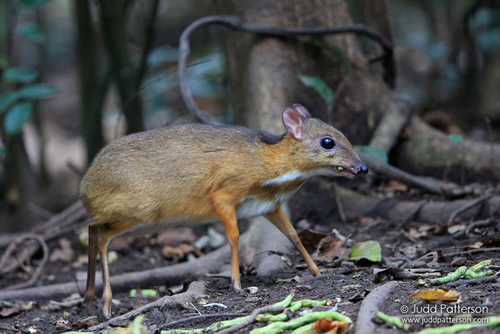
Lesser Oriental Chevrotain
Tragulus kanchil
Discover the 'mouse-deer' of Southeast Asia, a tiny, ancient survivor that navigates the jungle floor with pencil-thin legs and incredible stealth.
Quick Identification
Size
Length: 40–50 cm (16–20 in); Shoulder height: 18–22 cm (7–9 in); Weight: 1.5–2.5 kg (3.3–5.5 lbs)
Colors
Rufous-brown or reddish-orange upperparts with a dark nape stripe; white underparts and a characteristic white 'V' or 'Y' pattern on the throat.
Key Features
- Smallest ungulate in the world
- Pencil-thin legs with tiny cloven hooves
- Elongated canine 'tusks' in males instead of antlers
- Large, liquid-dark eyes for nocturnal vision
When You’ll See Them
Geographic range
Where Does the Lesser Oriental Chevrotain Live?
Native to the lush tropical landscapes of Southeast Asia, the Lesser Oriental Chevrotain is a true lowland specialist. Its core range spans from the dense forests of Southern Thailand and the Malay Peninsula across to the islands of Sumatra, Borneo, and various smaller archipelagos in Indonesia. While they are most abundant in undisturbed primary rainforests, they have also successfully established themselves in secondary growth areas and mangrove fringes throughout Vietnam, Laos, and Cambodia. Their distribution is closely tied to year-round tropical warmth and dense ground-level cover.
Basemap © OpenStreetMap contributors
Behavior
The Lesser Oriental Chevrotain, also known as the kanchil, is a shy and solitary creature that occupies the lowest strata of the Southeast Asian rainforest. Despite being a hoofed mammal, it behaves more like a large rodent or a rabbit, darting through dense undergrowth with surprising speed. They are primarily crepuscular and nocturnal, using their large eyes and sensitive noses to navigate the forest floor in search of fallen treasures. When threatened, they often freeze in place, relying on their camouflaged fur to blend into the leaf litter, only bolting at the very last second with a series of high-pitched squeaks.
In local folklore across Malaysia and Indonesia, the kanchil is celebrated as a 'trickster' figure, much like the fox in Western fables. This reputation comes from its ability to outsmart larger predators through sheer agility and cleverness. In the wild, they maintain small home ranges and are highly territorial. Males use their elongated upper canine teeth, which protrude like small tusks, to fight rivals during the breeding season. They rarely interact with humans and are notoriously difficult to spot without the aid of specialized camera traps.
EverydayEarth exclusive
Camera Tips
To capture the Lesser Oriental Chevrotain on camera, you must think small. Because these animals are barely 20 centimeters tall at the shoulder, a standard waist-high camera placement will likely only capture the top of their heads or miss them entirely. Mount your camera extremely low—between 15 and 30 centimeters (6-12 inches) off the ground. Angle the lens slightly upward if you are on a slope, or keep it perfectly level on flat ground to ensure you catch the full profile of this tiny ungulate.
Placement is everything for this shy species. Look for 'micro-trails'—tiny, narrow paths through dense ferns or undergrowth that look too small for a deer but too well-defined for a rat. They are particularly attracted to areas with fallen fruit, such as wild figs or rambutans. If you have a fruiting tree in your backyard or near a forest edge, aim your camera at the ground beneath the canopy where the fruit drops. Unlike larger mammals, chevrotains feel safest in shadows and thick cover, so avoid placing cameras in wide-open, sun-drenched clearings.
Because they are most active during the low-light hours of dawn, dusk, and night, ensure your camera has a high-quality infrared (IR) flash. White flashes will likely spook them and prevent them from returning. Set your trigger speed to the fastest possible setting; they are remarkably quick and can zip through the frame in a fraction of a second. Using 'Video Mode' with a 10-20 second duration is often more rewarding than still photos, as it allows you to observe their unique, delicate gait and 'freezing' behavior.
Seasonally, they are active year-round in their tropical range, but you may see increased activity during the transition between the dry and rainy seasons when forest fruits are most abundant. Ensure your camera housing is well-protected against humidity and ants, which are common in their habitat. A small desiccant pack inside the camera case can prevent the lens from fogging up in the humid tropical mornings when the Lesser Oriental Chevrotain is most likely to make an appearance.
Similar Species
Species that look similar or are commonly confused with Lesser Oriental Chevrotain.
Frequently Asked Questions
Record Lesser Oriental Chevrotain at your habitat
Connect a camera to start building your own species record — AI identifies every visitor automatically.