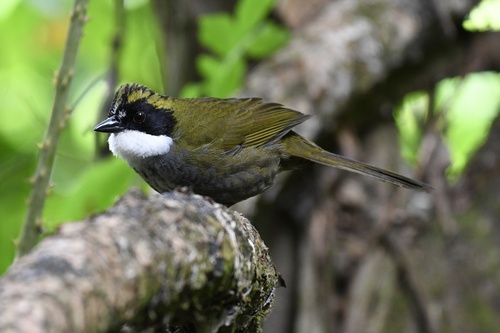
Green-striped Brushfinch
Arremon virenticeps
A secretive treasure of the Mexican highlands, the Green-striped Brushfinch is a master of the forest floor. With its bold striped crown and bright white throat, this endemic beauty brings a touch of mountain mystery to any backyard camera.
Quick Identification
Size
18–20 cm (7.1–7.9 in) in length; weight typically ranges from 40–55 grams
Colors
Dull olive-green upperparts and gray underparts with a bright white throat. The head features a bold black-and-white striped pattern with a unique olive-green median crown stripe. Males and females look identical.
Key Features
- Prominent olive-green stripe running down the center of a black crown
- Bright white throat patch sharply contrasted against gray underparts
- Heavy, conical dark bill typical of large sparrows
- Secretive behavior, primarily found hopping on the forest floor
When You’ll See Them
Geographic range
Where Does the Green-striped Brushfinch Live?
This bird is a proud endemic of North America, found exclusively within the mountainous regions of central and western Mexico. Its range is concentrated along the Sierra Madre Occidental and the Trans-Mexican Volcanic Belt, stretching from the state of Sinaloa down into northern Oaxaca. Within this territory, it is a permanent resident, meaning it does not migrate and can be observed in its highland forest home throughout the entire year.
Basemap © OpenStreetMap contributors
Behavior
The Green-striped Brushfinch is a shy, terrestrial bird that spends the majority of its life deep within the shadows of the forest understory. It is most famous for its 'double-scratch' foraging technique, where it hops and kicks back leaf litter with both feet simultaneously to uncover hidden insects and seeds. While they are usually found in pairs or small family groups, they are highly territorial and will defend their patch of scrub with sharp, metallic chipping calls.
Unlike many other finches that might be seen perched high in trees, this species rarely ventures more than a few meters above the ground. They are relatively habituated to humans in areas where gardens border protected forests, but they remain cautious, often retreating into thickets at the first sign of movement. During the breeding season, which typically follows the onset of the rains, males can be heard singing a series of thin, high-pitched whistles from low, hidden perches.
EverydayEarth exclusive
Camera Tips
To capture the elusive Green-striped Brushfinch on your backyard or trail camera, placement is everything. Because this species is almost exclusively terrestrial, you must set your camera very low to the ground—ideally no higher than 10 to 15 centimeters (4–6 inches). Angle the lens slightly upward to ensure you capture the diagnostic head stripes, which are their most striking feature. Look for 'scratch zones' in your yard or trail where the leaf litter has been disturbed; these are the bird’s preferred dining tables.
Water is a high-value attractant for this species, especially if you live in a region with a pronounced dry season. A low-profile, ground-level birdbath or a slow-dripping water feature positioned near dense cover will encourage them to linger in front of the lens. They are very cautious, so ensure the camera is tucked near the edge of a bush or hedge; they are unlikely to cross large, open patches of lawn to reach a camera site.
For the best image quality, prioritize cameras with fast trigger speeds and high PIR sensitivity, as these birds move with quick, jerky hops that can lead to blurred images on slower devices. Since they thrive in the dim light of the forest floor, check that your camera handles low-light conditions well without blowing out the whites of their throat patch. If you are using supplemental feed, a mix of small seeds and dried mealworms scattered directly on the ground (rather than in a hanging feeder) is the most effective way to lure them into frame.
Similar Species
Species that look similar or are commonly confused with Green-striped Brushfinch.
Frequently Asked Questions
Record Green-striped Brushfinch at your habitat
Connect a camera to start building your own species record — AI identifies every visitor automatically.