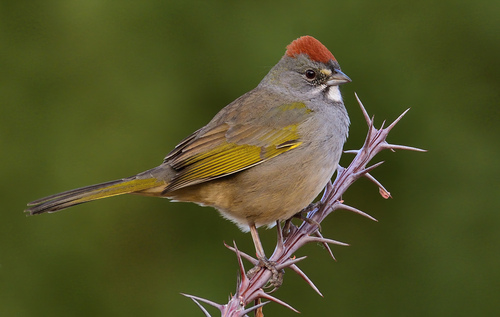
Green-tailed Towhee
Pipilo chlorurus
With its vibrant rufous cap and olive-green wings, the Green-tailed Towhee is a hidden gem of the Western brushlands. This energetic ground-dweller is famous for its unique 'double-scratch' dance and melodic, buzzy song.
Quick Identification
Size
Length: 7.1-8.3 in (18-21 cm); Wingspan: approx. 10 in (25 cm); Weight: 1.0-1.3 oz (28-38 g)
Colors
Gray body with a distinctive reddish-brown (rufous) crown, a bright white throat patch, and olive-green wings and tail.
Key Features
- Bright rufous (reddish-brown) crown
- Striking white throat patch bordered by dark 'mustache' stripes
- Vibrant olive-green wings and long tail
- Slate-gray chest and underparts
When You’ll See Them
Geographic range
Where Does the Green-tailed Towhee Live?
This bird is a native specialist of the Western North American interior, primarily breeding in the mountainous regions of the United States from the Great Basin to the Rocky Mountains. Its core range spans from eastern Washington and Oregon down through California, Nevada, and into New Mexico. As a migratory species, it travels south for the winter to inhabit the desert scrub landscapes of the Southwestern United States and throughout the Mexican plateau, where it remains common until the spring thaw.
Basemap © OpenStreetMap contributors
Behavior
The Green-tailed Towhee is the smallest of the towhees and is often characterized by its secretive yet energetic nature. It is most famous for its 'double-scratch' foraging technique, a rhythmic movement where the bird hops forward and then immediately kicks both feet backward to clear away leaf litter and soil in search of food. While they spend much of their time hidden in the shadows of dense brush, they are quite active and can be seen darting between shrubs with a characteristic springy hop.
During the breeding season, the males become much more visible, often perching on the highest branch of a sagebrush or mountain mahogany to belt out a series of complex, buzzy whistles. To humans, they are a charming presence, though they are easily spooked. Unlike some more urbanized sparrows, they tend to stay close to thick cover and will dive headfirst into the undergrowth if they perceive a threat, making them a rewarding challenge for backyard wildlife observers.
EverydayEarth exclusive
Camera Tips
To capture high-quality footage of a Green-tailed Towhee, you must focus on the ground. These birds are terrestrial specialists that rarely venture high into the canopy. Mount your AI-powered camera 6 to 12 inches above the ground, ideally aimed at a small clearing right at the edge of a thicket or hedge. This 'edge' zone provides them with the security they need to venture into the view of your lens while staying close to cover.
Water is the single most effective lure for this species, especially in the arid Western climates they inhabit. Use a very shallow ground-level birdbath or a simple saucer of water with a flat rock in the middle for a perch. Position the camera about 3 to 5 feet from the water source to ensure the bird fills the frame without being too close for the lens to focus. If you are using seed as a lure, avoid hanging feeders; instead, scatter a mix of white proso millet and sunflower hearts directly on the ground in a designated 'stage' area in front of the camera.
Because of their quick, jerky 'double-scratch' movements, it is vital to use a fast trigger speed. Set your camera to take 3-photo bursts or 10-second video clips to capture the full range of their behavior. The best lighting occurs in the early morning shortly after sunrise, which coincides with their peak foraging activity. During the summer, ensure your camera is positioned to avoid direct lens flare from the low-angle sun, as these birds will be most active when the light is most dramatic.
Similar Species
Species that look similar or are commonly confused with Green-tailed Towhee.
Frequently Asked Questions
Record Green-tailed Towhee at your habitat
Connect a camera to start building your own species record — AI identifies every visitor automatically.