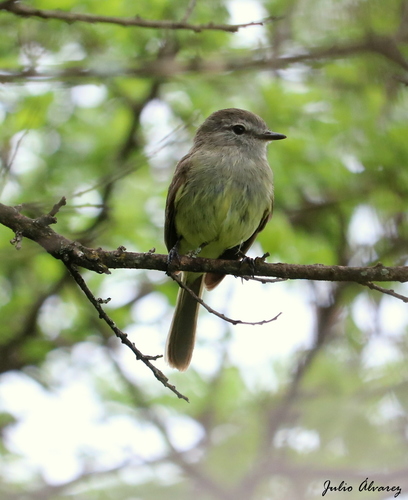
Greenish Elaenia
Myiopagis viridicata
A restless gem of the tropical canopy, the Greenish Elaenia is a master of camouflage and acrobatic flight. This small but energetic flycatcher is a frequent visitor to gardens and forest edges across the Americas.
Quick Identification
Size
Length: 13–14.5 cm (5.1–5.7 in); Weight: 10–14 g (0.35–0.49 oz)
Colors
Olive-green upperparts, pale yellowish belly, and grayish throat. Wings are dusky with two faint, pale wing bars.
Key Features
- Restless and active foraging behavior
- Concealed yellow crown patch visible when excited
- Inconspicuous crest often gives the head a slightly peaked appearance
- Relatively small, short bill
- Dull olive-green wash over most of the body
When You’ll See Them
Geographic range
Where Does the Greenish Elaenia Live?
The Greenish Elaenia is native to the Neotropics, with a massive range spanning from the northern tropical forests of Mexico through every country in Central America. In South America, it is found across the continent—from the Caribbean coast down to northern Argentina—staying primarily east of the Andes in the south, though it is notably absent from Chile and French Guiana. While primarily a resident of tropical and subtropical zones, it occasionally appears as a rare vagrant in the southernmost tip of Texas.
Basemap © OpenStreetMap contributors
Behavior
The Greenish Elaenia is a highly active and restless member of the tyrant flycatcher family. It is rarely still, constantly flitting through the mid-to-upper levels of the canopy in search of food. Unlike some flycatchers that sit and wait for long periods, this species is a frequent mover, often participating in mixed-species foraging flocks where it follows other birds to find flushed insects.
Its foraging style is distinctive; it often employs a 'hover-glean' technique, where it briefly stalls in flight to pluck an insect or berry from the underside of a leaf. While they are generally solitary or found in pairs, they are not particularly shy and can be found in proximity to human dwellings, provided there are enough mature trees or 'edge' habitat available. They are more often heard than seen, possessing a buzzy, descending call that is a hallmark of the tropical morning chorus.
EverydayEarth exclusive
Camera Tips
To capture the Greenish Elaenia on a backyard camera, you must look up. These birds are canopy and mid-story specialists, so placing a camera on the ground will rarely yield results. Mount your AI-powered camera 6 to 10 feet high on a tree trunk, angled slightly downward toward a horizontal 'perching branch' that has clear visibility and is near a source of berries or flowering plants. If you have fruit-bearing trees like Miconia or Trema, these are natural magnets for this species.
Because they are small and move with sudden, jerky motions, use a high trigger speed setting. If your camera supports it, enable a 'Pre-trigger' or 'Video' mode of at least 10 seconds. The Greenish Elaenia often hovers for a split second before grabbing food; this behavior is best captured in video or high-speed burst mode. Lighting is key for this olive-toned bird; try to position the camera so the sun is behind it (facing North if you are in the Northern Hemisphere) to prevent the bird from appearing as a dark silhouette against the bright sky.
Adding a water feature can significantly increase your success rate. A birdbath with a solar-powered dripper or a small fountain is especially attractive to Greenish Elaenias, as the sound of moving water draws them down from the high canopy for a drink or a quick bath. During the nesting season, they may also be seen lower to the ground gathering spiderwebs for nest construction, which is another excellent opportunity for close-up footage.
Similar Species
Species that look similar or are commonly confused with Greenish Elaenia.
Frequently Asked Questions
Record Greenish Elaenia at your habitat
Connect a camera to start building your own species record — AI identifies every visitor automatically.