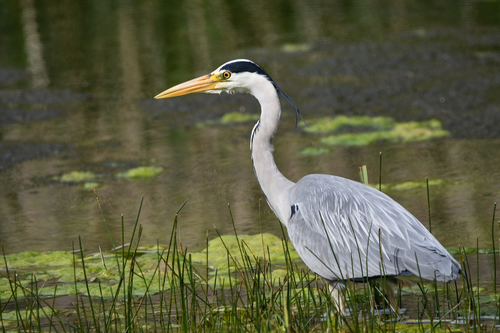
Grey Heron
Ardea cinerea
A silent, statuesque sentinel of the water's edge, the Grey Heron is the ultimate master of the 'long game.' Watch as this prehistoric-looking predator turns your backyard pond into its personal hunting ground.
Quick Identification
Size
Length: 84–102 cm (33–40 in); Wingspan: 155–195 cm (61–77 in); Weight: 1–2 kg (2.2–4.4 lb)
Colors
Slate-grey upperparts, white underparts with black streaks. White head with a distinctive black plume (crest) behind the eye. Yellowish-orange bill and brown legs.
Key Features
- Long, S-shaped neck often tucked in during flight
- Prominent black 'eyebrow' feathers ending in a long plume
- Slow, rhythmic wingbeats with deeply bowed wings
- Stiletto-like yellow bill used for spearing prey
When You’ll See Them
Sightings on EverydayEarth
Jul 31, 2026
A group of hippopotamuses is resting in the shallow water, with several submerged so only their backs, ears, and snouts are visible. On a fallen log near the center of the pond, a Grey Heron stands perfectly still, watching the water. In the background on the far right bank, a few more hippos are seen resting on the shore.
Jul 31, 2026
A pod of hippopotamuses is seen resting in a watering hole, with most of their bodies submerged to keep cool. One individual surfaces and performs a wide, dramatic yawn, showing its powerful jaws and tusks. On a partially submerged log in the water, a Grey Heron stands perfectly still, scanning the surface for movement.
Jul 30, 2026
A Grey Heron stands perched on a large, weathered log in the middle of a river. It remains mostly stationary, occasionally turning its head as it scans the surrounding water for potential prey.
Jul 30, 2026
A Common Hippopotamus rests submerged in a pool, with its head and ears clearly visible above the waterline. In the foreground, an African Spoonbill stands resting on a large boulder to the left, while a Grey Heron stands perched on the rocks to the right, surveying the water.
Jul 30, 2026
A Grey Heron stands prominently on a rock in the sun with its wings spread wide. This behavior is common for drying feathers or regulating body temperature near the water's edge.
Jul 29, 2026
A sunny morning at the waterhole reveals a diverse gathering of species. A large Nile Crocodile lies motionless on the far sandy bank, basking in the sun. In the foreground, several Egyptian Geese and White-faced Whistling-Ducks forage and rest along the shoreline, with some occasionally swimming into the rippling water. To the far left, a Grey Heron stands tall and still, watching for prey in the shallows.
Geographic range
Where Does the Grey Heron Live?
Native to a vast expanse of the Old World, the Grey Heron is a fixture across temperate Europe and Asia, reaching as far east as Japan and as far south as South Africa. While they are year-round residents in the United Kingdom and much of Western Europe, populations in the harsher climates of Scandinavia and Northern Russia migrate south to warmer Mediterranean or African regions for the winter. They are the most widely distributed heron species in their range, successfully colonizing almost any environment with a reliable source of shallow water.
Basemap © OpenStreetMap contributors
Recorded on EverydayEarth
Behavior
The Grey Heron is the ultimate master of patience, often found standing perfectly still at the water's edge for hours. This "sit-and-wait" predator relies on stealth and sudden, explosive speed to snatch prey. While they are solitary hunters that fiercely defend their feeding territories, they are surprisingly social during the breeding season. They gather in large, noisy colonies called heronries, typically building massive stick nests high in the canopy of tall trees.
In urban and suburban settings, Grey Herons have adapted remarkably well. They are clever enough to recognize human patterns, often visiting garden ponds at dawn to hunt goldfish before homeowners awake. Despite their large, imposing size, they are incredibly light due to their hollow bones, allowing them to take off with a single powerful leap and a deep, croaking 'fraaank' call that sounds like something from the prehistoric era.
EverydayEarth exclusive
Camera Tips
To capture high-quality footage of a Grey Heron, placement is everything. These birds are tall, so avoid the common mistake of pointing your camera too low. Mount your AI-powered camera on a stake or tripod at a height of about 2 to 3 feet, aiming slightly upward if you are close to the water's edge. Because they spend so much time standing still, a camera with a fast trigger speed is essential to catch the split-second moment they strike at a fish. Set your camera to 'Video' or 'Photo Burst' mode with a 30-second interval to ensure you see the hunt from start to finish.
If you have a backyard pond, place the camera on the opposite side of the heron’s likely landing spot. Herons prefer an open area with a clear view of potential predators, so they often land a few feet away from the water and walk in. Use the 'Quiet' or 'No Glow' infrared settings if your camera has them; while herons are largely diurnal, they are most active during the twilight hours of dawn and dusk when standard white flashes might startle them and ruin the natural behavior you're trying to document.
You can also use 'natural lures' by ensuring your pond has a shallow 'beach' area or a flat rock just below the water's surface. This provides the perfect hunting platform for the heron. Look for signs of their presence, such as large, four-toed footprints in the mud or white streaks of droppings (guano) on nearby posts. During the spring, keep an eye on the sky—you might capture them flying low with large sticks in their bills, a sure sign they are building a nest nearby.
Similar Species
Species that look similar or are commonly confused with Grey Heron.
Frequently Asked Questions
Record Grey Heron at your habitat
Connect a camera to start building your own species record — AI identifies every visitor automatically.