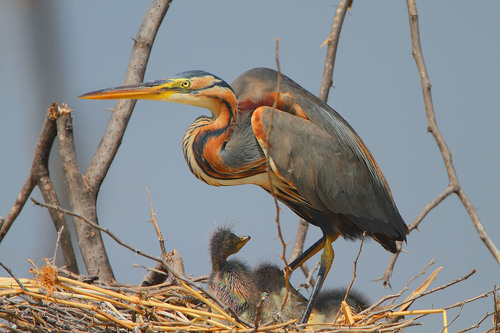
Purple Heron
Ardea purpurea
Meet the 'Ghost of the Reeds,' a slender and secretive master of camouflage. With its striking chestnut plumage and snake-like grace, the Purple Heron is the ultimate prize for any backyard wildlife observer.
Quick Identification
Size
Length: 78-97 cm (31-38 in) | Wingspan: 120-152 cm (47-60 in) | Weight: 0.5-1.35 kg (1.1-3 lbs)
Colors
Rich rufous-brown and slate-grey plumage with distinctive black stripes running down a long, slender chestnut neck; dark cap with thin black crest plumes.
Key Features
- Extremely slender, 'snake-like' neck with dark longitudinal stripes
- Deep reddish-purple tint to the plumage in bright light
- Elongated yellow bill and large, splayed feet for walking on floating vegetation
- Angular, narrow head profile compared to other large herons
When You’ll See Them
Behavior
The Purple Heron is a master of camouflage and stealth, far more secretive than its cousin, the Grey Heron. It is a solitary bird that spends much of its time motionless within dense reed beds, often adopting a 'bittern-like' pose with its neck stretched upward to blend in with the surrounding vegetation. Unlike many other water birds that frequent open shorelines, this species prefers the safety of the 'edge zone' where thick reeds meet shallow water.
When hunting, the Purple Heron is incredibly patient. It may stand perfectly still for nearly an hour, waiting for prey to come within striking distance, or it may wade with excruciatingly slow, deliberate steps. It is a crepuscular hunter, meaning it is most active during the twilight hours of dawn and dusk, though it will forage during the day when feeding hungry chicks in the nest.
EverydayEarth exclusive
Camera Tips
Capturing a Purple Heron on a backyard or trail camera requires a strategic approach because of their extreme shyness. Unlike more social herons, the Purple Heron will avoid any area with significant human activity. To increase your chances, position your camera at the very edge of a water source where natural cover like reeds, tall grasses, or overhanging branches is present. Set the camera low—about 1 to 2 feet off the ground—angled slightly upward to capture the full length of their incredibly long necks as they forage.
Since these birds are most active during low-light hours (dawn and dusk), a camera with a high-quality infrared sensor and a fast trigger speed is essential. Avoid using white-flash cameras, as the sudden burst will likely spook the bird and prevent it from returning to that spot for days. Instead, rely on 'no-glow' or 'low-glow' infrared LEDs. Set your camera to 'Video Mode' with a 20-30 second duration; the Purple Heron’s movements are often so slow and subtle that a single still photo might miss the action of a strike or a stretch.
Do not attempt to bait Purple Herons with food, as they are wild hunters that prefer live, moving prey. Instead, focus on 'visual corridors.' Look for natural gaps in the reeds or 'runs' where the water is shallow enough for wading but close to deep cover. If you have a backyard pond, ensure you have a 'wild corner' with dense aquatic plants. Position your camera facing north or south to avoid lens flare during the golden hours when these birds are most likely to step out of the shadows and into your frame.
Similar Species
Species that look similar or are commonly confused with Purple Heron.
Grey Heron
Larger and paler with a thicker neck; much bolder and more likely to be seen in open water or suburban gardens.
Eurasian Bittern
Stockier build with shorter legs and a thicker neck; lacks the purple/chestnut tones and has mottled brown 'owl-like' camouflage.
Black-crowned Night Heron
Much shorter and stockier with shorter legs; lacks the long, striped neck of the Purple Heron.
Frequently Asked Questions
Record Purple Heron at your habitat
Connect a camera to start building your own species record — AI identifies every visitor automatically.